


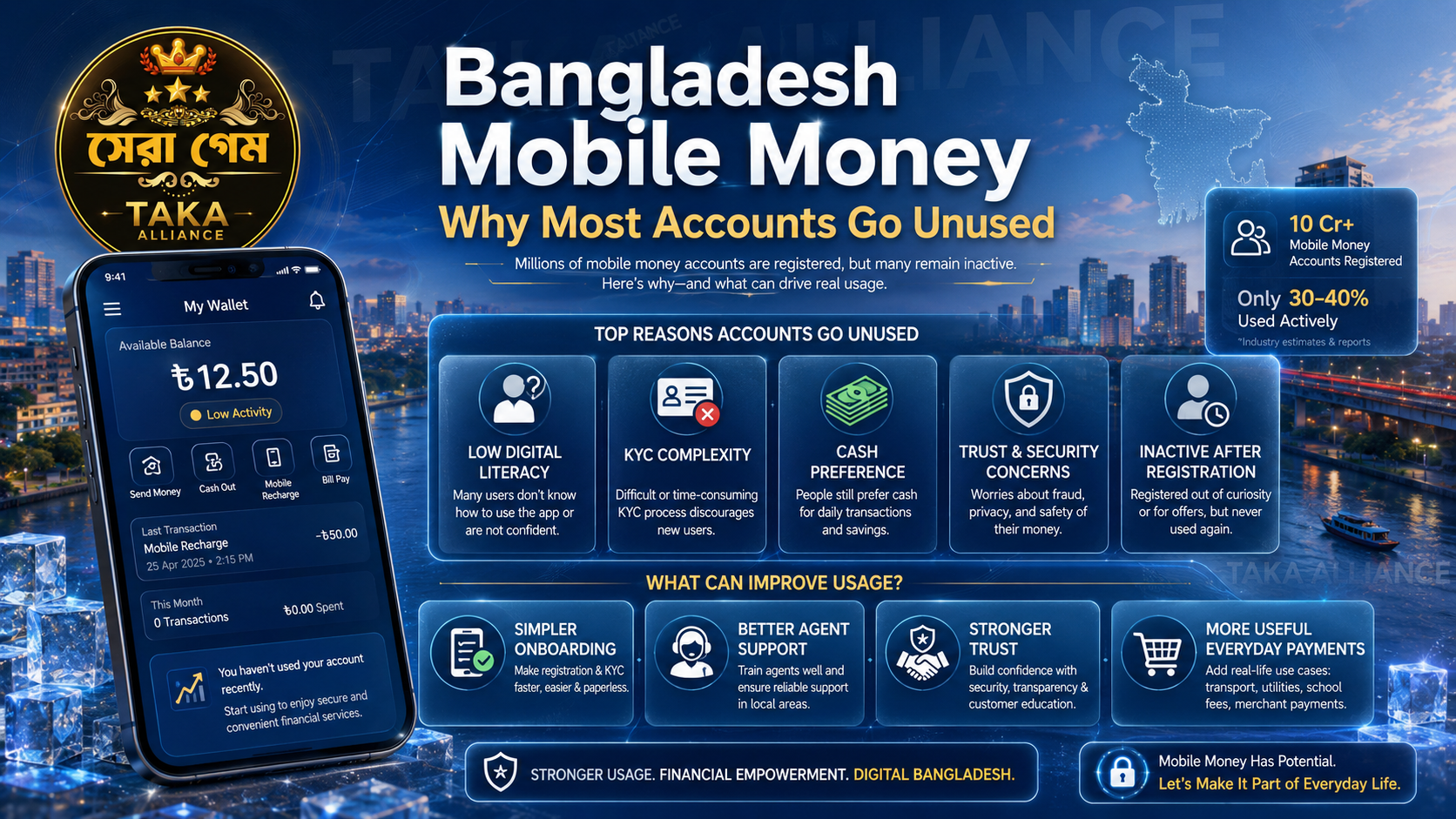
Bangladesh mobile money looks like a runaway success from a distance, and in many ways it is. Reported figures put registered mobile financial service accounts at roughly 236.7 million by December 2024, up from about 220.1 million a year earlier, with average daily transaction value reported up around 34 percent year on year. Get closer, though, and a quieter number changes the whole picture: by the same reporting, only about 37.6 percent of those accounts were active. Most of the accounts on the books barely move. That gap, between people who signed up and people who actually use the thing, is the real story of Bangladesh mobile money in 2026, and it is not an accident. It comes from expensive data, some of the slowest internet in South Asia, older phones, and a quiet lack of confidence, especially among rural users and women. This piece looks at the gap honestly, explains why it has been so hard to close, and lays out how an ordinary person can turn a dormant bKash, Nagad or Rocket account into one that genuinely earns its place in daily life.
Tuesday morning, around quarter past nine. Sadia, 34, teaches at a school in Bogura, and she was digging through her purse for cash to pay a tuition bill when it hit her that she had three mobile money accounts and used almost none of them. One came bundled with a SIM offer. Her brother set up another during Eid so he could send her something. The third she opened to receive a single month’s salary that never came again. On paper, Sadia is three of the country’s hundreds of millions of accounts. In real life she is a cash person who taps her phone maybe twice a month, and usually only because someone else nags her into it. She is not hostile to the technology. She just finds the data charges irritating, the app fiddly on her old handset, and she has heard enough scam stories from neighbours to feel a low hum of worry every time she opens it. Stack up millions of Sadias and you get a country that can lead the region in sign-ups and still trail it in actual use. She is who this article is for.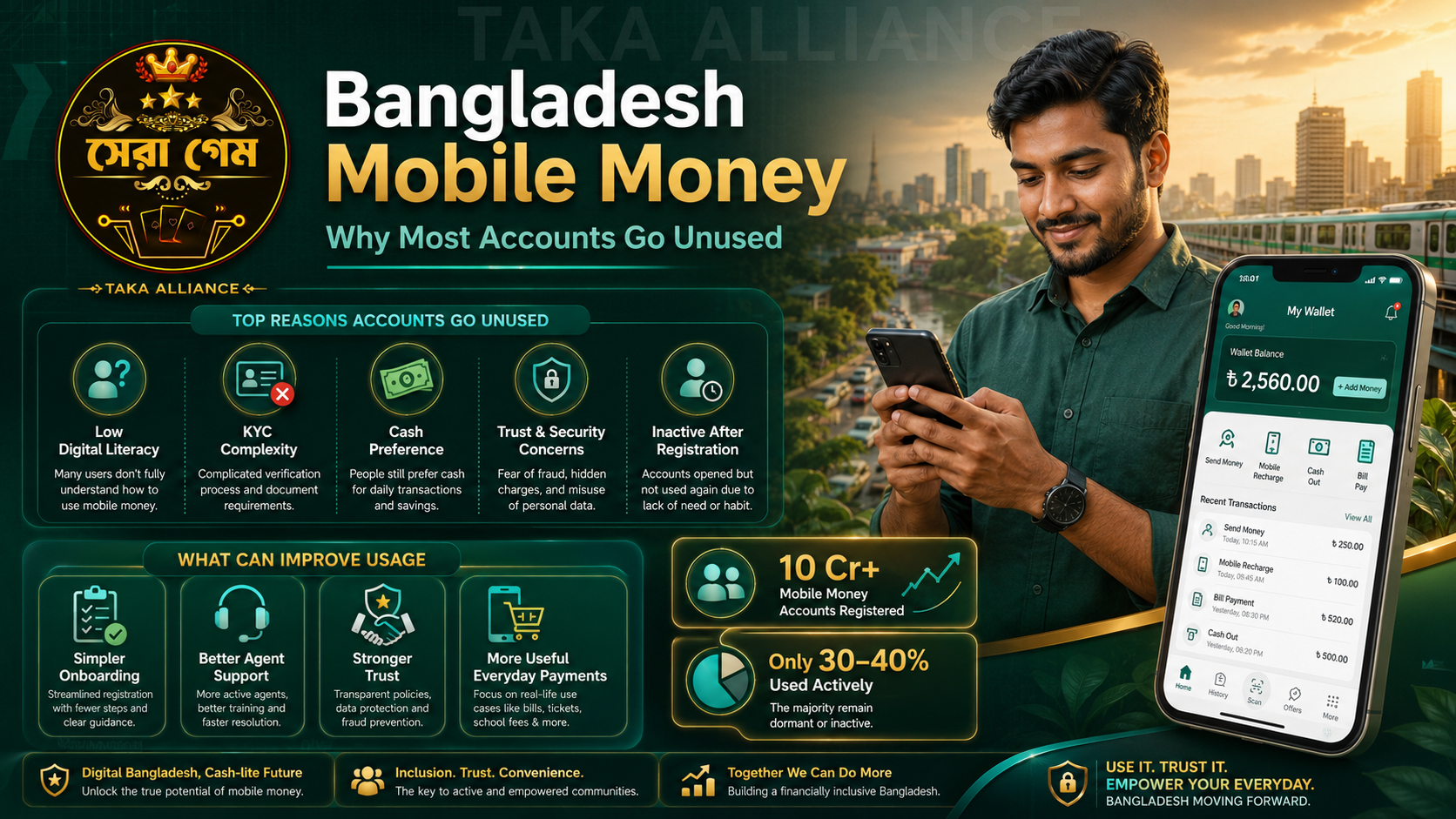
What Does It Mean That Most Bangladesh Mobile Money Accounts Go Unused?
It means registration has raced far ahead of real use. Bangladesh mobile money now counts hundreds of millions of registered accounts, yet reporting suggests only around 37.6 percent were active as of late 2024. A clear majority exist as names on a list, with no regular transactions behind them. The growth is real. It just flatters how digital everyday life has actually become.
A registered account and an active one are not the same animal. One is a sign-up, often done for a single reason and then forgotten, such as grabbing a SIM promotion or collecting one payment. The other is a wallet someone reaches for without thinking, the way they reach for cash. When the active share hovers in the high thirties, that tells you most accounts are dormant rather than alive. By reach, Bangladesh genuinely leads, and it helps that more than 90 percent of the country’s internet users get online through a smartphone. But reach and habit are different things. Read the headline totals on their own and you will badly overestimate how much of daily money has actually moved onto phones.
This takes nothing away from the achievement. Going from almost no formal financial access to hundreds of millions of accounts inside a decade is remarkable by any standard. The point is simply that the next problem is a different shape. Phase one was getting people to sign up, and the country won it. Phase two, the slow one, is getting them to come back tomorrow.
Why Do So Many Registered MFS Accounts Stay Inactive?
Because the obstacles pile on top of one another. Sector reporting points to high data costs, internet among the slowest in South Asia, older budget phones, and shaky digital confidence, sharpest among rural users and women. Any one of these is a mild annoyance. Together they quietly convince people that an account is something you open once and leave alone.
The trap is that the barriers feed each other. Pricey data means you open the app less, so you never get comfortable, so you fall back on cash, which makes the next data charge feel even more pointless. A slow old phone makes the screen feel cramped and the buttons risky, so a son or a husband ends up doing the transaction, and the account holder learns nothing. Layer scam rumours on top, and ordinary caution curdles into outright avoidance. The table below sorts the main barriers by who they hit hardest and what actually shifts them, so the problem reads as fixable rather than fuzzy. Treat the emphasis as directional, drawn from sector reporting rather than one official survey.
| Barrier | Who it hits hardest | Why it blocks active use | What actually helps |
|---|---|---|---|
| High data costs | Low-income, rural users | Opening the app feels like spending money | Lighter apps, cheaper bundles, offline-friendly flows |
| Slow internet | Outside the big cities | App lags, and a stalled transfer feels risky | Network investment, USSD and SMS fallback |
| Older budget phones | First-time and elderly users | Cramped screen, fear of pressing the wrong thing | Simpler menus, bigger text, clear confirmations |
| Low digital confidence | Rural users and women | A relative transacts for them, so they never learn | Hands-on local help, agent support, Bangla-first guidance |
| Scam fear | Everyone, newcomers most | Caution hardens into avoiding the app entirely | Plain, repeated safety education and visible support |
If you spot your own account in one of those rows, you are in very ordinary company, and the answer is rarely about trying harder. It is about killing one specific bit of friction. When you are weighing which service handles these everyday frustrations best, our honest comparison of mobile wallets is a sensible place to start.
How Do Data Costs and Slow Internet Keep People From Using Mobile Money?
They turn a simple payment into a small cost-benefit sum. When data is expensive next to what people earn and the connection crawls, opening a money app stops feeling free or instant. For a small everyday payment, plenty of people quietly decide that cash is just easier, and they are not wrong to.
It is easy to wave this away from a Gulshan flat with fast fibre and a fat data plan. Shift the scene to a smaller town and a tight budget and the arithmetic flips. A transfer that should take seconds can hang on a weak signal, leaving you staring at the screen, unsure whether the money went or not. That moment, the not-knowing, is the most stressful thing in mobile money and the quickest route to giving up on it. The real cost is not just the megabytes; it is the uncertainty, because a frozen transaction feels far worse than simply handing over a hundred-taka note. Until the everyday experience is reliably quick and cheap enough to feel free, a big chunk of accounts will keep defaulting to cash for exactly the small, frequent payments that fill up a normal day. If a transfer has ever stalled or thrown an error on you mid-payment, our payment errors playbook explains what each message means and how to sort it safely.
The hopeful part is that this is the most fixable barrier on the whole list, because it is about money and engineering rather than habit or culture. Cheaper data, stronger coverage, and apps light enough to run on a slow line would wake up a real slice of these dormant accounts without asking a single person to change who they are.
What Does the Active-Use Gap Mean for bKash, Nagad and Rocket?
For the providers, it is a warning dressed as an opportunity. bKash, Nagad and Rocket have mostly won the sign-up race already, with bKash reported as Bangladesh’s first tech unicorn, valued north of two billion US dollars. The contest that decides the next decade is different: not who registers the most users, but who turns silent accounts into daily habits.
That changes what good even looks like. In the sign-up years, winning meant agents in every upazila and promotions on every billboard. In the active-use years, winning means a payment that never freezes, a screen a nervous first-timer can trust, fees that do not bite on a small transfer, and support that actually answers when something breaks. Each provider already runs official guidance and help channels, and those pages, such as bKash, Nagad and Rocket, are the right first stop when a genuine transaction stalls or gets questioned. Whoever makes the daily experience feel effortless and safe is the one most likely to revive dormant accounts, because the missing ingredient was never desire. People already signed up. They have just never been handed enough reason, or enough confidence, to open the app again.
There is a bigger stake hiding behind the corporate metric. Reported daily transaction value climbing around 34 percent year on year shows the active core is leaning harder on these wallets even as the long tail sits still. Great for revenue, yes, but it also means real financial inclusion is only half done, and that is why the gap is a national question, not just a boardroom one.
How Does Bangladesh’s Active-Use Gap Compare With Its Neighbours?
Bangladesh leads the region on raw reach but trails on day-to-day use. Reporting that flagged the active share near 37.6 percent framed it specifically against neighbours where a larger slice of registered accounts actually transact. The sign-up totals are world-class. The everyday habit behind them is where Bangladesh mobile money still has ground to make up.
The comparison is worth sitting with, because it pushes back on a comforting story. It is easy to read “hundreds of millions of accounts” as a finished job, a problem already solved. Set next to peers who turned a higher proportion of their sign-ups into regular users, the picture looks less like a finish line and more like a strong first lap. The difference rarely comes down to one dramatic policy. It tends to be the unglamorous stuff: data that costs a little less, networks that drop fewer transactions, apps that ask a little less of a nervous user. Small edges, compounded across millions of people, are what separate a country where accounts get used from one where they mostly wait. A neighbour who shaved a few taka off a data bundle, or smoothed out one stalled-transfer headache, did not change human nature; they just removed a reason to reach for cash instead, and that quiet difference is the whole ball game.
None of this is a reason for gloom. Bangladesh built its reach faster than almost anyone expected, and the same drive that signed people up can, with the right nudges, get them transacting. The honest framing is competitive rather than critical: the country is winning on access and has a clear, catchable target on active use, with neighbours showing it is reachable rather than theoretical.
How Can a Bangladesh User Get Real Value From a Mobile Money Account?
Pick one or two useful jobs and stop there at first. The fastest way to make a dormant account worth keeping is to push a single recurring payment through it, a monthly bill, school fees, money sent home, so the habit grows around something you already do anyway.
A few things make that easier in practice. Choose one main account instead of half-using three, because one familiar app beats three confusing ones every time. Learn the exact steps for your most common task and repeat them until they feel boring, since confidence comes from doing the same thing twice, not from reading every menu once. Guard your PIN and login, and never read out a one-time code to anyone, because that one habit blocks most fraud on its own. Keep a little balance sitting there, so a quick payment does not turn into a top-up first, which is the friction that sends people straight back to cash. For getting the basics right from start to finish, our complete bKash deposit guide and our Nagad payments and gaming guide spell out the steps in plain language, and our mobile wallet versus bank transfer comparison helps you pick the right tool when the amount gets bigger.
Value follows use, not the other way around. An idle account does nothing but sit there. The day it carries one real task you would otherwise queue up for in cash, it starts paying you back in time and trips saved, and that first small habit is almost always what flips a forgotten sign-up into a wallet you actually trust.
What Needs to Change for Active Use to Catch Up With Sign-Ups?
Three things, pulling in the same direction. Everyday access has to get cheaper and faster, the apps have to get simpler for older and first-time users, and confidence has to be built through hands-on, Bangla-first help, especially for rural users and women. Sign-ups answered to promotions. Active use answers to friction disappearing.
Each lever wakes a different group. Cheaper data and better coverage reach the budget-watcher for whom every transaction is a small expense. Lighter, simpler apps reach the person on an ageing phone who dreads tapping the wrong button. Local, practical training reaches the user who hands the phone to a relative and never learns the steps. Plain, repeated safety education reaches the cautious newcomer who avoids the app because the scam stories outweigh the perks in their head. None of these is a single dramatic fix, and that is exactly the realistic picture; the gap will close the way it opened, slowly, through a hundred small improvements rather than one breakthrough. On the safety side, which is one of the biggest confidence blockers of all, our guide to spotting impersonation and phishing lays out the warning signs in plain terms, and the official Bangladesh Bank site is the authoritative word on how the formal system is regulated.
So the mood here is optimistic but unhurried. Bangladesh already did the hard part, which was reaching people who had never touched formal finance. Turning that reach into routine is slower and far less glamorous, but it is squarely doable, and every barrier on the list has a known, practical answer waiting. You can follow how the sector and its rules keep shifting through our latest Bangladesh digital and payments news hub, and the deeper story of how payments are now watched sits in our AI monitoring breakdown. For the wider list of services we have actually tested, see the TAKA ALLIANCE verified platform directory.
Frequently Asked Questions
How many mobile money accounts does Bangladesh actually have?
Reporting put registered mobile financial service accounts at roughly 236.7 million by December 2024, up from about 220.1 million a year before. That is a reported snapshot, not a live total, so confirm the current figure against Bangladesh Bank’s official MFS statistics before treating any number as today’s exact count.
Why are most of those accounts inactive?
By the same reporting, only around 37.6 percent were active. The usual culprits are high data costs, slow internet, older budget phones, low confidence among rural users and women, and plain scam fear. These feed each other, so an account often stays dormant until one specific bit of friction is removed.
What counts as an active mobile money account?
An active account is generally one that has actually transacted within a recent set window, rather than just existing on a list. A registered account is only a sign-up. That difference is how Bangladesh can lead the region in total accounts while most of them sit idle with no regular use behind them.
Is bKash, Nagad or Rocket the best one to actually use?
There is no single winner for everyone. The right pick depends on where your contacts and billers already are, the fee on your most common transaction, and which app runs smoothly on your phone. Our honest comparison of the three weighs speed, fees and everyday reliability so you can settle on one main account.
How do I get value from an account I never use?
Route one regular payment through it, a monthly bill or money sent home, and repeat that single flow until it feels routine. Value follows use. The moment an account carries one task you would otherwise do in cash, it starts saving you time and trips and quietly stops being a dead sign-up.
Why does mobile data cost matter so much for usage?
When data is expensive next to income and speeds are slow, opening a money app stops feeling free or instant. People weigh the cost and the wait against the convenience, and for small payments they often go with cash. Cheaper data and lighter apps are among the most direct ways to revive dormant accounts.
Is it safe to rely on mobile money in Bangladesh?
The formal system is regulated by Bangladesh Bank, and the providers run their own support channels, so legitimate use is broadly safe as long as you protect your PIN and never share a one-time code. Most losses come from scams and impersonation, not the system itself, which is why basic safety habits matter as much as the tech.
What would make more people use their accounts regularly?
Cheaper and faster everyday access, simpler apps for older and first-time users, hands-on Bangla-first training to build confidence, and clear, repeated safety education. Sign-ups responded to promotions, but active use responds to friction vanishing. The gap closes gradually through many small improvements rather than one single change.
See our latest Bangladesh digital and payments news hub for ongoing coverage, and our honest mobile wallet comparison if you are deciding which account to make your main one.
Last updated: June 2026
Reviewed by Michael Max.
About the Author