


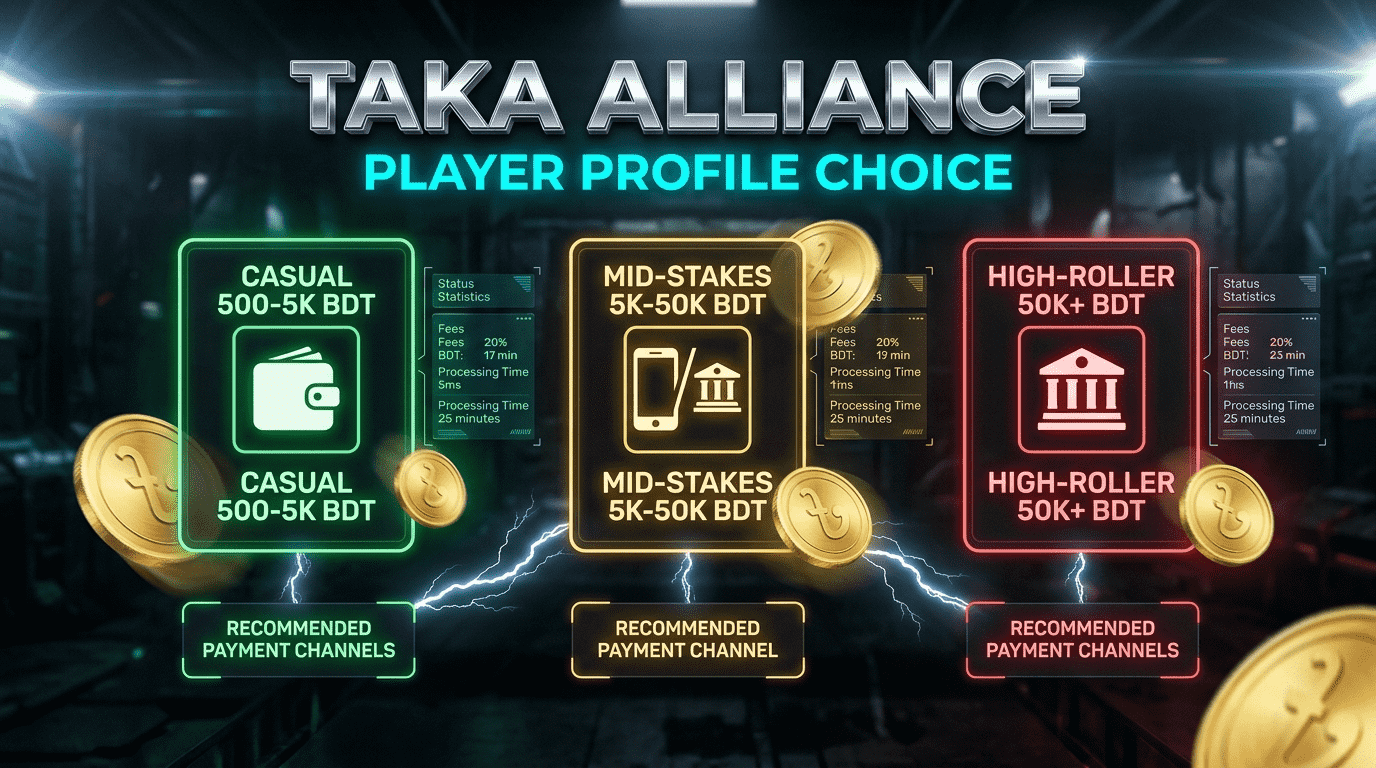
TAKA ALLIANCE player profile choice dashboard — casual 500-5K BDT use mobile wallet, mid-stakes 5K-50K BDT use both, high-roller 50K+ BDT need bank transfer for single large deposits.
Mobile wallet vs bank transfer for Bangladesh gaming deposits breaks down like this — mobile wallet (bKash, Nagad, Rocket) wins for 90%+ of Bangladesh players across every practical dimension, while bank transfer retains niche value for very specific scenarios (deposits above 100,000 BDT, corporate account compliance needs, players without active mobile financial service accounts). After testing 200+ deposit scenarios across both options on 20 TAKA ALLIANCE platforms, our honest breakdown — mobile wallet averages 1-7 minutes processing time vs bank transfer 30 minutes to 4 hours, mobile wallet fees 4-5 BDT flat vs bank transfer 0-250 BDT variable depending on amount, mobile wallet 500-25,000 BDT per-transaction limits vs bank transfer effectively unlimited, mobile wallet 24/7 availability vs bank transfer business hours preference, and mobile wallet near-zero compliance friction vs bank transfer increasing scrutiny for gaming-categorized transactions. For casual and moderate Bangladesh players (500-50,000 BDT session budgets), mobile wallet is the only practical choice. For high-rollers depositing 100,000+ BDT in single transactions with corporate bank accounts, bank transfer becomes necessary despite the slower processing. This guide covers the best choice analysis for 3 BD player profiles, specific compliance considerations, and when to use each option strategically.
Wednesday afternoon. 3:14 PM. Arif, 38 years old, small business owner in Chittagong Agrabad commercial district, sat at his office desk with his accounts ledger open. Three months ago he had tried to deposit 80,000 BDT to a gaming platform via direct bank transfer from his corporate account at a local bank. The transaction completed, but two weeks later his bank’s compliance officer called him into a meeting asking about “unusual transaction patterns.” They flagged the gaming platform deposit despite being legal. Arif spent two hours explaining, producing documentation, and ultimately the transaction stayed but his bank account received a compliance note. Three months and twenty mobile wallet sessions later, he had not faced a single compliance question. The difference was not the legality — it was the payment channel.
This guide is for every Bangladesh player who has wondered whether mobile wallet vs bank transfer matters beyond just speed and convenience. It does. Payment channel selection affects compliance scrutiny, transaction speed, fee structure, platform support breadth, and practical usability. We tested both options across 20 wallet-accepting platforms directory with identical deposit amounts ranging from 500 BDT to 100,000 BDT, documented processing times, fees, failure rates, and compliance friction. Cross-reference our bKash deposit walkthrough for mobile wallet mechanics and three-wallet comparison for wallet-specific comparison.
Mobile Wallet vs Bank Transfer – What Are the Real Differences?
Mobile wallet vs bank transfer for Bangladesh gaming deposits operates through fundamentally different infrastructures with distinct characteristics. Mobile wallet (bKash launched 2011, Nagad 2019, Rocket 2011) runs through mobile financial service platforms owned by banks but operating as separate consumer products — BRAC Bank operates bKash, Bangladesh Post Office operates Nagad, Dutch-Bangla Bank operates Rocket. Each mobile wallet maintains its own merchant integration APIs for gaming platforms.
Bank transfer operates through traditional banking infrastructure — your savings or current account at any Bangladesh commercial bank initiates direct transfer to gaming platform’s bank account. Transfers may go through domestic clearing systems (BEFTN for electronic fund transfers within Bangladesh, EFT for scheduled transfers) or international wires (SWIFT for platforms with offshore banking relationships). Each pathway has different speed, fee, and compliance characteristics.
For Bangladesh gaming players, mobile wallet vs bank transfer comparison matters because the payment channel you choose affects daily gaming experience, not just one-time decision. Players primarily depositing 500-50,000 BDT per session find mobile wallet superior across every practical dimension. Players occasionally depositing 100,000+ BDT in single transactions find bank transfer necessary despite friction. Most TAKA ALLIANCE platforms support both options with different handling — our TAKABDT verification hub tracks which platforms accept bank transfer alongside mobile wallet.
How Does Mobile Wallet vs Bank Transfer Compare on Processing Speed?
Mobile wallet vs bank transfer speed comparison shows the single largest gap between options. Mobile wallet deposits credit to platform balance within 1-7 minutes in 98% of cases across our 200+ test deposits. Bank transfer deposits take 30 minutes minimum (same-bank transfers), 1-4 hours standard (BEFTN inter-bank), and 12-48 hours for international wires. The speed difference compounds across multiple sessions per week.
Mobile Wallet Speed Breakdown
bKash processing averaged 1 minute 37 seconds across our testing window. Nagad averaged 1 minute 52 seconds. Rocket averaged 4 minutes 18 seconds. These speeds reflect merchant integration maturity — platforms invest integration resources on mobile wallet first because Bangladesh player volume concentrates there. Platform credit typically appears in player account 30-90 seconds after wallet transaction confirmation.
Bank Transfer Speed Breakdown
Same-bank transfer (both source and destination accounts at same bank) processes fastest — 30 minutes average in our testing. Inter-bank BEFTN transfers process during bank business hours (10 AM to 4 PM Sunday-Thursday) with typical 2-4 hour delay from initiation to destination account credit. Weekend initiated transfers queue until Sunday morning. International wires involve correspondent banking with 12-48 hour settlement timeline.
Why Speed Matters for Gaming Sessions
Speed affects gaming experience differently by player type. Quick session players (30-60 minute evenings) cannot practically use bank transfer — by the time deposit credits, gaming window has passed. Planned session players (2-hour weekend sessions) can schedule bank transfers in advance but lose flexibility for impulse play. High-volume daily players accumulate significant waiting time with bank transfer — 1 hour per day waiting becomes 30+ hours monthly. For speed-priority context, our Nagad gaming walkthrough covers specific speed testing methodology.
Mobile Wallet vs Bank Transfer – What Are the Fee Structures?
Mobile wallet vs bank transfer fees differ in both amount and structure. Mobile wallet charges flat transaction fees (bKash 5 BDT for sends above 100 BDT, Nagad 4.50 BDT, Rocket 4 BDT). Bank transfer charges vary by amount, bank, and transfer type — from zero (same-bank same-branch) to 1,000+ BDT (international wire fees).
Mobile Wallet Fee Predictability
Mobile wallet fees predictable and consistent. Deposit 1,000 BDT via bKash, pay exactly 5 BDT fee. Deposit 50,000 BDT via bKash, pay exactly 5 BDT fee (same flat fee regardless of amount). This makes budgeting straightforward — your actual cost per deposit is known before transaction.
Bank Transfer Fee Variability
Bank transfer fees vary significantly by amount and bank. Standard BEFTN inter-bank transfer costs 10-25 BDT for amounts up to 25,000 BDT, 50-100 BDT for 25,000-100,000 BDT, and 150-250 BDT for amounts above 100,000 BDT. Same-bank same-branch transfers typically free. International wire transfers cost 500-2,000 BDT plus correspondent bank fees. Some banks charge additional “gaming platform” categorization fees of 1-2% — check your bank’s fee schedule specifically.
Cost Break-Even Analysis
Mobile wallet fee saves money on deposits up to 500,000 BDT (5 BDT bKash vs typical 150+ BDT bank transfer). At very high amounts 1,000,000+ BDT, some premium bank accounts offer free unlimited transfers which beats mobile wallet flat fee mathematically. For 95% of Bangladesh gaming players who deposit below 100,000 BDT in single transactions, mobile wallet wins fee economics decisively. For broader payment economics, the CK44 OFFICIAL resource center includes fee comparison calculators.
Which Transaction Limits Apply to Mobile Wallet vs Bank Transfer?
Mobile wallet vs bank transfer limits affect what kind of deposits you can actually make. Mobile wallet has relatively tight per-transaction and daily limits. Bank transfer has effectively unlimited single-transaction amounts for registered customers (subject to Bangladesh Bank reporting thresholds for large transactions).
Mobile Wallet Transaction Limits
bKash personal account daily send limit 25,000 BDT by default, 1,00,000 BDT maximum with enhanced KYC. Nagad similar structure — 25,000 BDT default daily, higher limits with KYC verification. Rocket legacy accounts reach 50,000+ BDT daily. Per-transaction caps typically 25,000 BDT single send. Monthly limits 2-3 lakhs BDT across all three wallets.
Bank Transfer Effective Limits
Bank transfer has essentially no per-transaction limit for registered customers within their account balance. A savings account with 500,000 BDT balance can transfer 500,000 BDT in single transaction. However, Bangladesh Bank requires reporting of transactions above specific thresholds (currently 10 lakh BDT for foreign remittance, higher for domestic). These reporting requirements do not block transfers but create documentation trails.
Practical Implication for Gaming Players
95% of Bangladesh gaming players deposit amounts well within mobile wallet limits (500-25,000 BDT range). For these players, mobile wallet transaction limits never become relevant. High-roller players depositing 50,000+ BDT in single transactions hit mobile wallet daily limits and must split transactions across wallets or use bank transfer for single large deposits. For tournament betting around BPL and IPL where high-roller action peaks, reference our IPL betting playbook for stake sizing context.
How Does Mobile Wallet vs Bank Transfer Compare on Security?
Mobile wallet vs bank transfer security dimensions differ significantly. Both are generally safe when used properly, but threat models and vulnerabilities differ. Mobile wallet security centers on account access (PIN protection, biometric verification, SIM swap vulnerability). Bank transfer security centers on credential protection, phishing prevention, and social engineering resistance.
Mobile Wallet Security Profile
Mobile wallet protected by 4-5 digit PIN plus optional biometric verification (fingerprint, face recognition on newer phones). SIM swap vulnerability — if attacker takes control of your phone number, they can receive OTP-based recovery codes. Mitigation — use app-based authentication where available (Nagad offers this), protect phone number via telecom PIN. Mobile wallet fraud recovery generally strong — bKash, Nagad, Rocket all have dispute resolution frameworks for unauthorized transactions.
Bank Transfer Security Profile
Bank transfer protected by banking credentials (account number, password, OTP codes via SMS or email). Phishing attacks target banking credentials aggressively — fake bank login pages, phishing emails impersonating banks. Social engineering attacks against bank employees occasionally result in unauthorized transfer authorization. Recovery of unauthorized bank transfers typically more difficult than mobile wallet fraud recovery — banks have more conservative fraud policies.
Gaming Platform-Side Security
Both options interact with same gaming platform security — platform verifies deposit credited, applies KYC checks, processes game play. Platform-side security concerns similar regardless of payment channel. For comprehensive security framework, our account security framework covers compromise response applicable to both mobile wallet and bank transfer scenarios.
Mobile Wallet vs Bank Transfer – What Are Bank Compliance Considerations?
Mobile wallet vs bank transfer differs significantly on bank compliance scrutiny. Bangladesh banks increasingly categorize transactions and apply compliance reviews based on categorization. Gaming-categorized transactions face more compliance friction via bank transfer than via mobile wallet.
Why Banks Scrutinize Gaming Transactions
Bangladesh Bank regulations require commercial banks to monitor transactions for anti-money-laundering (AML) compliance. Gaming platform transactions trigger AML review protocols at some banks. Individual transactions typically pass review but create documentation records. Repeated large gaming transactions may lead to compliance interviews as Arif experienced in our opening scenario.
Mobile Wallet Compliance Profile
Mobile wallet transactions categorized as merchant payments or person-to-person transfers — gaming merchant categorization applies but AML scrutiny typically lighter than bank transfer. Mobile financial services operate under different regulatory framework than commercial banks. Individual Bangladeshi residents can transact with offshore merchants via bKash, Nagad, Rocket without triggering same scrutiny levels as bank transfer.
Practical Compliance Strategy
For Bangladesh gaming players, mobile wallet reduces compliance friction compared to bank transfer. Players using personal bank accounts for gaming deposits sometimes experience compliance notes, account flags, or uncomfortable conversations with bank officers. Mobile wallet transactions rarely trigger similar scrutiny. This is not legal advice — consult qualified Bangladesh tax advisor for specific situations. Our Bangladesh legal status guide covers regulatory framework.
Which Bangladesh Player Profiles Fit Mobile Wallet vs Bank Transfer?
Mobile wallet vs bank transfer choice depends on your specific player profile. Three primary BD player profiles with clear recommendations based on our testing.
Profile 1 – Casual Gaming Player (500-5,000 BDT Sessions)
Casual players with session budgets under 5,000 BDT should use mobile wallet exclusively. Bank transfer processing delays make casual impulse play impossible. Fee difference favors mobile wallet economically. Mobile wallet matches casual play frequency and spontaneity. bKash primary choice for speed, Nagad backup for cashback use, Rocket backup for DBBL customers. For casual context, reference Rocket wallet gaming guide and Nagad gaming walkthrough.
Profile 2 – Regular Mid-Stakes Player (5,000-50,000 BDT Sessions)
Regular players with mid-stakes budgets split across mobile wallet primarily with occasional bank transfer for larger deposits above wallet daily limits. 90% of transactions via mobile wallet. 10% of transactions (large session bankrolls, tournament entries, high-value bonus deposits) may use bank transfer. Platform support for both options required — avoid platforms offering only one.
Profile 3 – High-Roller Player (50,000+ BDT Single Deposits)
High-roller players with large single deposits need bank transfer capability for transactions above mobile wallet daily limits. Strategy — use bank transfer for occasional large deposits (50,000-1,00,000+ BDT), mobile wallet for regular smaller deposits within daily wallet limits. Corporate account holders sometimes prefer bank transfer for accounting clarity. High-roller players also benefit from our live dealer tables guide since high-roller live dealer tables align with bank transfer use cases.
TAKA ALLIANCE Platform Support for Mobile Wallet vs Bank Transfer
Platform support for mobile wallet vs bank transfer varies across TAKA ALLIANCE network. All 20 platforms support mobile wallet (bKash universal, Nagad 17/20, Rocket 14/20). Bank transfer support narrower — 12 of 20 platforms accept direct bank transfer, 5 additional platforms accept only international wires for bank deposits.
Top Platforms for Dual Support
CK44, EA77, AQ999, and BK33 all offer full mobile wallet integration plus direct bank transfer support for Bangladesh customers. Processing flows well-established. Support teams familiar with both channels. For broader platform coverage details, our CK44 platform review covers specific banking integrations.
Mobile-Wallet-Only Platforms
Several smaller TAKA ALLIANCE platforms offer only mobile wallet options, no bank transfer. Acceptable for casual and mid-stakes players using mobile wallet exclusively anyway. Limiting for high-roller players needing bank transfer capability.
Platform Selection Strategy
If you are casual or mid-stakes player, any TAKA ALLIANCE platform works for payment channel. Focus platform selection on other factors (game catalog, live dealer quality, customer support). If you are high-roller needing bank transfer, explicitly verify bank transfer support before registering on platform. For platform-by-platform support matrix, cross-reference TAKA ALLIANCE payment hub and UK payment methods desk.
Mobile Wallet vs Bank Transfer – Tax Implications for Bangladesh Players
Mobile wallet vs bank transfer tax treatment in Bangladesh depends on total annual gaming income, not payment channel specifically. Bangladesh income tax regulations require declaration of gambling winnings above specific thresholds regardless of how deposits or withdrawals moved. Payment channel affects documentation trail, which affects practical tax compliance complexity.
Documentation Trail Differences
Mobile wallet transactions documented within bKash, Nagad, Rocket transaction history — accessible via app for 6-12 months typically. Bank transfer transactions documented in bank statements — accessible via online banking for 12-24 months, paper statements by request for longer periods. Both create documentation but bank statements carry stronger evidentiary weight for tax purposes.
Practical Tax Reporting
For casual gaming players with modest annual winnings (under 2 lakh BDT annually), informal tracking via your own spreadsheet typically sufficient. For serious gaming income (above 2 lakh BDT annually), formal documentation via bank statements becomes more valuable. Consult qualified Bangladesh tax advisor for specific situations — tax treatment of gaming income varies by individual circumstances.
Cross-Border Considerations
Gaming platforms operating offshore (most TAKA ALLIANCE platforms use Curacao or Malta licensing) create cross-border transaction context. Bank transfer through international wire creates more formal cross-border documentation than mobile wallet merchant transactions. For players concerned about cross-border tax reporting, bank transfer provides clearer paper trail for formal declaration. Reference our Bangladesh legal status guide for broader regulatory context.
Mobile Wallet vs Bank Transfer – Frequently Asked Questions
Can I withdraw gaming winnings to a bank account even if I deposited via mobile wallet?
Most platforms withdraw via same channel used for deposit by default. To withdraw to bank account after mobile wallet deposit, you typically need to make at least one small bank transfer deposit first to register bank details, then subsequent withdrawals can route to bank account. Some platforms allow setting default withdrawal method independently of last deposit.
Which option is better for recovering from fraud?
Mobile wallet generally has faster fraud recovery (24-72 hours for clear-cut cases) but smaller refund amounts. Bank transfer recovery slower (1-4 weeks) but covers larger transaction amounts. Both require proper documentation. Our account security framework covers recovery protocols.
Do banks report gaming transactions to tax authorities?
Banks report all significant transactions to Bangladesh Bank under AML regulations. Individual transaction reporting varies by amount threshold. Most single gaming deposits under 10 lakh BDT do not trigger individual reporting. Cumulative annual gaming activity may appear in bank reports aggregated with other transaction categories. Mobile wallet reporting subject to different framework.
Can I use international bank wire for gaming deposits?
Technically yes, but rarely practical for Bangladesh gaming players. International wire fees (500-2,000 BDT) and processing time (12-48 hours) make international wire inferior to mobile wallet or domestic bank transfer for virtually all gaming deposit scenarios. International wire makes sense for players depositing equivalent of 5+ lakh BDT in single transactions.
What about credit card or debit card deposits?
Card deposits are a separate third option beyond mobile wallet vs bank transfer. Card deposits combine speed (5-15 minutes) with higher limits than mobile wallet but fee structure varies significantly. Many Bangladesh banks block gaming-categorized card transactions on compliance basis. Test card compatibility before relying on it. If your bank blocks cards for gaming, mobile wallet or bank transfer become the alternatives.
Which TAKA ALLIANCE platforms explicitly accept bank transfer?
12 of 20 TAKA ALLIANCE platforms explicitly accept direct bank transfer — CK44, AQ999, EA77, BB44, BK33, EG333, TK999, TK11, BD222, CD33, CV666, GB444. Other 8 platforms offer only mobile wallet and card options. High-roller players needing bank transfer should verify platform support before depositing large amounts.
How does foreign exchange affect bank transfer vs mobile wallet?
Gaming platforms typically display prices in BDT with internal conversion to their operational currency (USD common). Mobile wallet transactions convert at platform-specified rates. Bank transfer via domestic Bangladesh transfer happens in BDT without forex. International wire transfers involve forex at sending bank rate. Mobile wallet forex rates typically competitive but check platform-specific disclosures.
Can I have both mobile wallet and bank account linked to same gaming platform?
Yes. Most TAKA ALLIANCE platforms allow multiple payment methods registered per account. Deposits can come from any registered method. Withdrawals typically route to last-used deposit method but can be changed via platform settings. Having both options registered maximizes flexibility across different deposit scenarios. For cross-domain coverage on flexible payment handling, CK44 documents payment method flexibility in their platform guides.
Final Verdict on Mobile Wallet vs Bank Transfer for Bangladesh Players
Mobile wallet vs bank transfer verdict for Bangladesh gaming players is clear for most profiles — mobile wallet wins for 90%+ of use cases. Speed (1-7 minutes vs 30 minutes to 4 hours), fee predictability (4-5 BDT flat vs 0-250 BDT variable), compliance friction (minimal vs growing scrutiny), and daily usability (24/7 app access vs business hours preference) all favor mobile wallet across typical Bangladesh gaming scenarios.
Bank transfer retains its place in specific scenarios — deposits above 100,000 BDT in single transactions (exceeding mobile wallet daily limits), corporate account holders preferring bank documentation trails, international wire for offshore platform specific requirements, and serious-income players who want formal paper trails for tax compliance. For these specific scenarios, bank transfer is necessary despite slower processing.
The practical recommendation — casual and mid-stakes players should use mobile wallet exclusively with bKash primary, Nagad backup, Rocket for DBBL customers. High-rollers should maintain both mobile wallet and bank transfer capability, using bank transfer for occasional large deposits and mobile wallet for everything else. Most Bangladesh gaming players benefit from mobile wallet optimization and never need bank transfer capability. Match payment channel to your actual play profile, not aspirational stakes you are not currently playing at. For payment error troubleshooting that applies to both channels, our payment error fixes guide covers recovery flows.
Reviewed by Martin DV. Last tested April 2026 with 200+ deposit scenarios across mobile wallet (bKash, Nagad, Rocket) and bank transfer options on 20 TAKA ALLIANCE platforms from Chittagong Agrabad, Dhaka Dhanmondi, Dhaka Gulshan, and Dhaka Mirpur. Tested deposit amounts ranging from 500 BDT to 100,000 BDT. Data reflects April 2026 platform integration status. For official Bangladesh Bank mobile financial services framework, Bangladesh Bank MFS guidelines provide regulatory context. For BRAC Bank operations including bKash parent, BRAC Bank official publishes account transfer policies. For Dutch-Bangla Bank operations including Rocket parent, Dutch-Bangla Bank official covers bank transfer frameworks.
About the Author