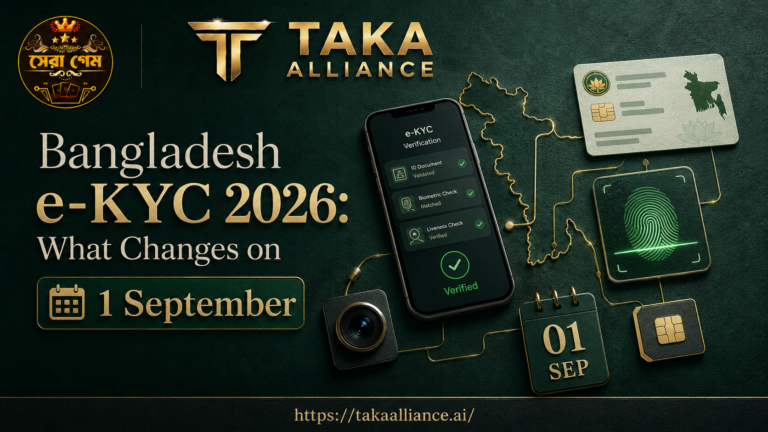




Bangladesh e-KYC 2026 rules take effect on 1 September 2026 under Bangladesh Bank’s updated guidelines. They apply across scheduled banks, finance companies, Mobile Financial Services providers, Payment Service Providers, Payment System Operators and other payment services. The framework uses NID data and biometric matching, while preserving a traditional KYC route when digital verification fails or a citizen does not have an NID.
Under Bangladesh e-KYC 2026, the most visible change for customers may be a more consistent digital onboarding journey: identity details, OTP checks, a fingerprint or face match and risk-based account review. The guidelines also make an important fairness point. A person should not be denied financial service solely because an NID is unavailable.
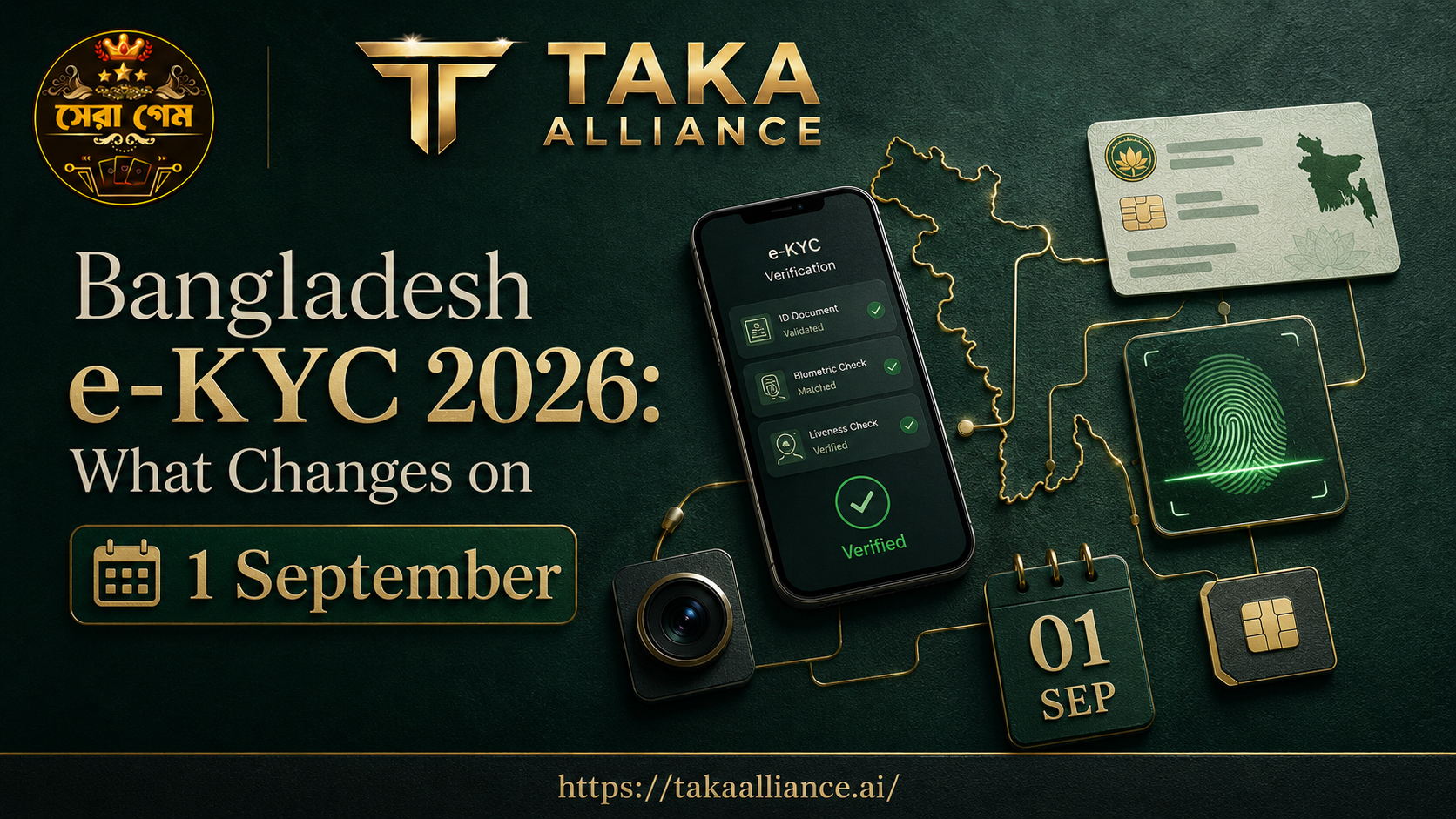
Bangladesh’s updated e-KYC framework combines NID data, biometric checks, risk-based review and a traditional KYC fallback.
Table of Contents
- What e-KYC actually means
- Why Bangladesh is tightening it
- When the rules start
- Who is covered
- Who feels the change first
- The customer journey
- Face and fingerprint checks
- If you have no NID
- If e-KYC fails
- Simplified and regular paths
- Data and privacy
- Scam-safe verification
- How this fits the wider 2026 picture
- FAQ
Primary source: The requirements come from Bangladesh Bank’s updated e-KYC guidelines issued with BRPD Circular No. 08 on 11 March 2026.
What Does e-KYC Actually Mean?
KYC stands for Know Your Customer. It is the set of checks a financial provider runs to confirm who is opening an account and to understand how that account is likely to be used. The traditional version relied on paper forms, a physical copy of an identity document and a signature verified at a branch counter. e-KYC keeps the same goal and moves the process to a digital channel, so that a customer can be identified through an app or an assisted screen instead of a folder of photocopies.
In practice, electronic KYC blends a few familiar steps. Identity details are captured and checked against an approved source, contact information is confirmed, a biometric sample links the person to the record, and the provider reviews the risk attached to the customer and the product. None of these ideas is new. What is new is the expectation that they happen in a consistent, verifiable digital flow across the whole financial sector rather than in whatever format each institution invented for itself.
It helps to remember what e-KYC is not. It is not a single national app that everyone must download, and it is not a way to open an account with no identity at all. It is a shared method for proving identity that different licensed providers can follow, so a customer’s experience at a bank starts to resemble the experience at a mobile wallet.
Why Is Bangladesh Tightening e-KYC Now?
Two pressures push in the same direction. The first is inclusion. Millions of people in Bangladesh reached formal finance through mobile wallets rather than a branch, and a fast, remote onboarding process is the only realistic way to serve customers who may never visit a counter. A clear digital standard lets a genuine customer open an account from a village without travelling to a city.
The second pressure is fraud. As money and identity moved online, so did the people trying to abuse them. Weak or inconsistent onboarding lets criminals open accounts under stolen or invented identities, and those accounts then move stolen funds or launder them through many small transfers. A firmer, uniform e-KYC standard is meant to raise the cost of that abuse without shutting out honest users. Tightening the rules is less about adding friction for its own sake and more about closing the gaps that fraud rings have learned to exploit.
There is a regulatory logic underneath all of this. When every provider verifies identity to a similar level, the whole system becomes easier to supervise, and a bad actor cannot simply shop for the weakest door. That is why Bangladesh e-KYC 2026 reaches across banks and wallets and payment operators at the same time rather than fixing one corner and leaving the rest.
When Does Bangladesh e-KYC 2026 Take Effect?
The updated guidelines become effective on 1 September 2026 and replace the related previous instructions identified in the circular. Institutions have the period before that date to adjust onboarding systems, policies, reporting and staff procedures.
Customers may see changes at different times during implementation, but a provider should explain whether a journey is fully digital, assisted or handled through traditional KYC. An app update or new face prompt should be verified through the provider’s official channel.
Which Institutions Are Covered?
The framework applies to scheduled banks, finance companies, MFS providers, PSPs, PSOs and other payment services. This wide scope is designed to create stronger consistency across the financial system rather than treating a bank account and a mobile wallet as completely unrelated identity processes.
Exact product eligibility can still vary. A low-risk wallet and a complex business account may require different documents, limits and review.
Who Feels the Change First?
The heaviest lifting falls on the institutions, not on customers. Banks and finance companies have to align their onboarding software, staff training and reporting with the new standard, and larger organisations often carry older systems that are not simple to update. For them, the months before September are about testing that identity checks, biometric matching and fallback routes all behave the way the guidelines expect.
Mobile Financial Services providers such as bKash and Nagad sit at the front line because so many first accounts in Bangladesh are wallets. These providers already onboard customers at scale and at speed, so a change to how identity is captured touches millions of everyday sign-ups. A smoother, standardised flow could reduce failed registrations, while any rough edges will be felt quickly by a very large user base.
Telecom operators are part of the picture in a supporting role, because the mobile number and the OTP that confirms it are woven into most digital onboarding. A phone number tied to a verified subscriber is one of the quiet building blocks of a trustworthy account, which is why SIM registration and financial identity keep bumping into each other.
Ordinary users and small businesses feel the change last but in the most practical way. For an individual, the payoff is meant to be a cleaner sign-up and fewer trips to a branch. For a small trader opening a merchant or business account, the process may ask for more information where risk is higher, so it is worth keeping identity records current and starting only from an official channel. The goal is that the extra care happens once, at onboarding, rather than as repeated friction later.
What Could a Normal e-KYC Journey Look Like?
- The customer starts through an official app, website, branch or authorised agent.
- NID details are captured and checked against the approved source.
- Contact information may be confirmed with an OTP.
- A fingerprint or face image is matched as the permitted biometric step.
- The institution performs sanctions, risk and account-purpose checks.
- The customer receives confirmation, limits and terms through a verified channel.
The exact screen order is controlled by each institution and the applicable product. Never let an unknown caller remotely control the phone during onboarding.
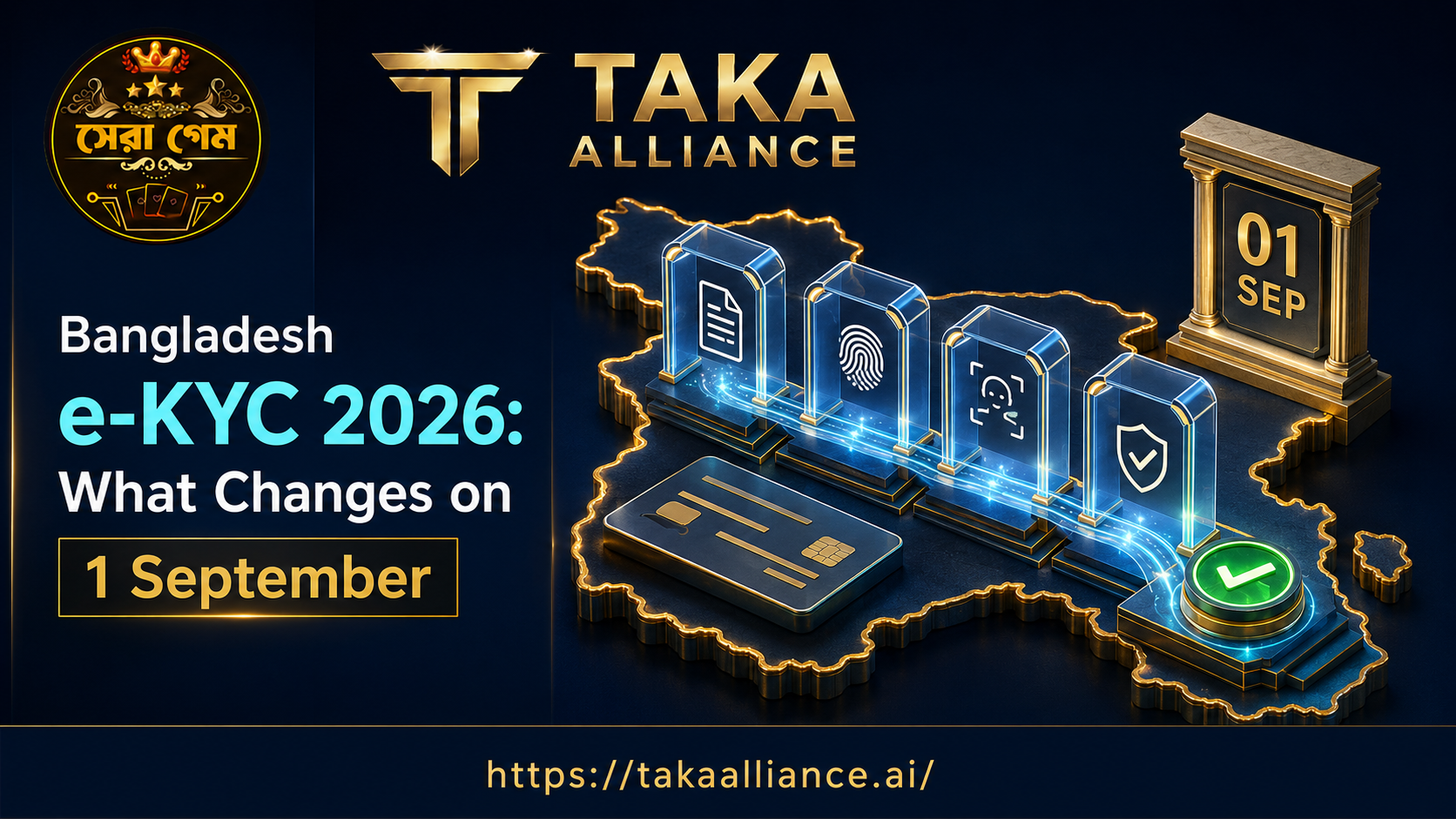
A typical e-KYC journey connects identity data, contact confirmation, biometric matching and account approval.
Are Both Face and Fingerprint Required?
The guidelines provide for biometric verification using fingerprint or face matching. That wording allows an approved route to use the appropriate method rather than forcing every customer through both in every case.
A genuine biometric check should happen inside the verified service or an authorised process. A face video requested through a chat link, unofficial APK or screen-sharing session is a warning sign. Financial staff should never need the customer’s OTP, PIN or password to “complete” a face match.
Can Someone Without an NID Be Refused Automatically?
No. The guidelines say a citizen should not be denied service solely for not having an NID. The institution can follow traditional KYC and apply additional measures appropriate to the person and product.
This is important for inclusion. It does not mean an account can be opened with no identity checks. It means the absence of one credential should lead to an alternative lawful verification route rather than an automatic exclusion.
What Happens If the Digital Check Fails?
If the technical e-KYC attempt fails, traditional KYC should be followed. A mismatch can happen because of image quality, connectivity, an outdated record or another technical issue. It is not automatically proof of fraud.
Customers should ask for the official fallback route and keep any reference number. Do not pay a stranger who promises to “unlock” an NID or bypass a biometric mismatch.
What Are Simplified and Regular e-KYC Paths?
The framework supports risk-based onboarding. A simplified path can be suitable for eligible lower-risk products, while regular or enhanced measures apply where the customer, product, transaction pattern or ownership structure requires more review.
Simplified does not mean anonymous. Core identity checks and monitoring remain. Enhanced review is not necessarily an accusation; it can be a standard response to higher limits, business activity or complex ownership.
For a customer, the practical takeaway is that not every account will ask for the same things. A basic wallet with modest limits may onboard in minutes, while a business account that will move larger sums can reasonably attract more questions. Both outcomes are normal, and neither one means the customer has done something wrong.
How Should e-KYC Data Be Protected?
The guidelines require attention to security and confidentiality and refer to local hosting or private-cloud arrangements. Identity data should be collected for a defined purpose, protected from unauthorised access and retained according to applicable requirements.
Institutions also have reporting duties. Banks and finance companies follow the stated quarterly reporting route, while payment services follow Payment Systems Department instructions. Reporting supports oversight but does not remove the provider’s duty to secure each customer’s information.
Data protection is not only a matter for the provider. Because e-KYC ties an account to a face, a fingerprint and an NID, the value of that record to a criminal is high, and the customer’s own habits matter too. Sharing an NID image in a public post or a group chat undoes some of the care the standard is built to enforce, so it is worth treating identity documents as carefully as a bank card.
How Can Customers Verify Safely?
- Begin only from the institution’s official app, website, branch or verified agent.
- Do not install an APK from a message or advertisement.
- Never disclose an OTP, PIN or password to a caller.
- Reject unexpected screen-sharing and Accessibility requests.
- Check the provider’s official support number if a verification step feels unusual.
- Keep confirmation messages but do not post NID images publicly.
A real September deadline does not justify pressure from a stranger. Scammers often attach urgent language to genuine policy changes. Customers should verify the process independently before sharing identity data.
How Does Bangladesh e-KYC 2026 Fit the Wider Picture?
The new Bangladesh e-KYC 2026 standard is one piece of a much larger year for money and identity in Bangladesh. Payments are being standardised at the counter through the national QR programme, and identity is being standardised at the door through these onboarding rules. Both share the same instinct, which is to make the honest path simpler while making the fraudulent path harder. Readers following the rollout of the Bangla QR payment standard will recognise the pattern, since a common identity check and a common payment code are two halves of the same push toward a cleaner system.
The urgency behind stricter onboarding is easier to understand next to the year’s fraud story. Banking trojans like the one we covered in the GoldPickaxe mobile banking report and the steady stream of bKash phishing scams both aim at the same target, which is a real person’s identity and access. Stronger e-KYC will not stop those attacks on its own, but it raises the effort needed to open the fake accounts that so often receive stolen money.
Enforcement has been moving in parallel. The action described in our coverage of frozen MFS accounts shows regulators willing to close accounts linked to suspicious activity, and firmer identity checks make that kind of cleanup more precise. For an ordinary user, the connection is simple. A system that knows its genuine customers better can act against the fake ones with a lighter touch on everyone else.
Bangladesh e-KYC 2026 FAQ
When do the updated rules start?
They take effect on 1 September 2026.
Which providers are included?
Scheduled banks, finance companies, MFS providers, PSPs, PSOs and other payment services are within scope.
What is e-KYC in simple terms?
It is the digital version of the identity check a provider runs before opening an account. It confirms who you are using identity data and a biometric step instead of relying only on paper forms.
What if I do not have an NID?
You should not be denied solely for that reason. Traditional KYC and additional lawful measures can be used.
What if face or fingerprint verification fails?
The guidelines provide for a traditional KYC fallback when the technical e-KYC attempt fails. Ask for the official route and keep any reference number.
Does e-KYC replace my bank or wallet app?
No. It is a shared way of verifying identity, not a new account or app. You still use your existing bank or MFS provider, and the standard shapes how they confirm who you are.
Should I share an OTP with an agent?
No. An OTP is an authentication secret and should not be disclosed to a caller or chat contact, even one who says it is needed to finish verification.
The Bangladesh e-KYC 2026 change arriving in September is quieter than the headlines around it, and that is a good sign. A well-run identity check should feel like an ordinary step rather than an obstacle, and the standard’s real success will be measured in accounts that open smoothly for honest customers while fake ones find fewer places to hide. Customers who start from an official channel, guard their OTP and treat their NID like a bank card will meet the new rules with very little friction.
Last source review: 30 July 2026. Institutions should consult the full Bangladesh Bank circular for implementation details.
About the Author