


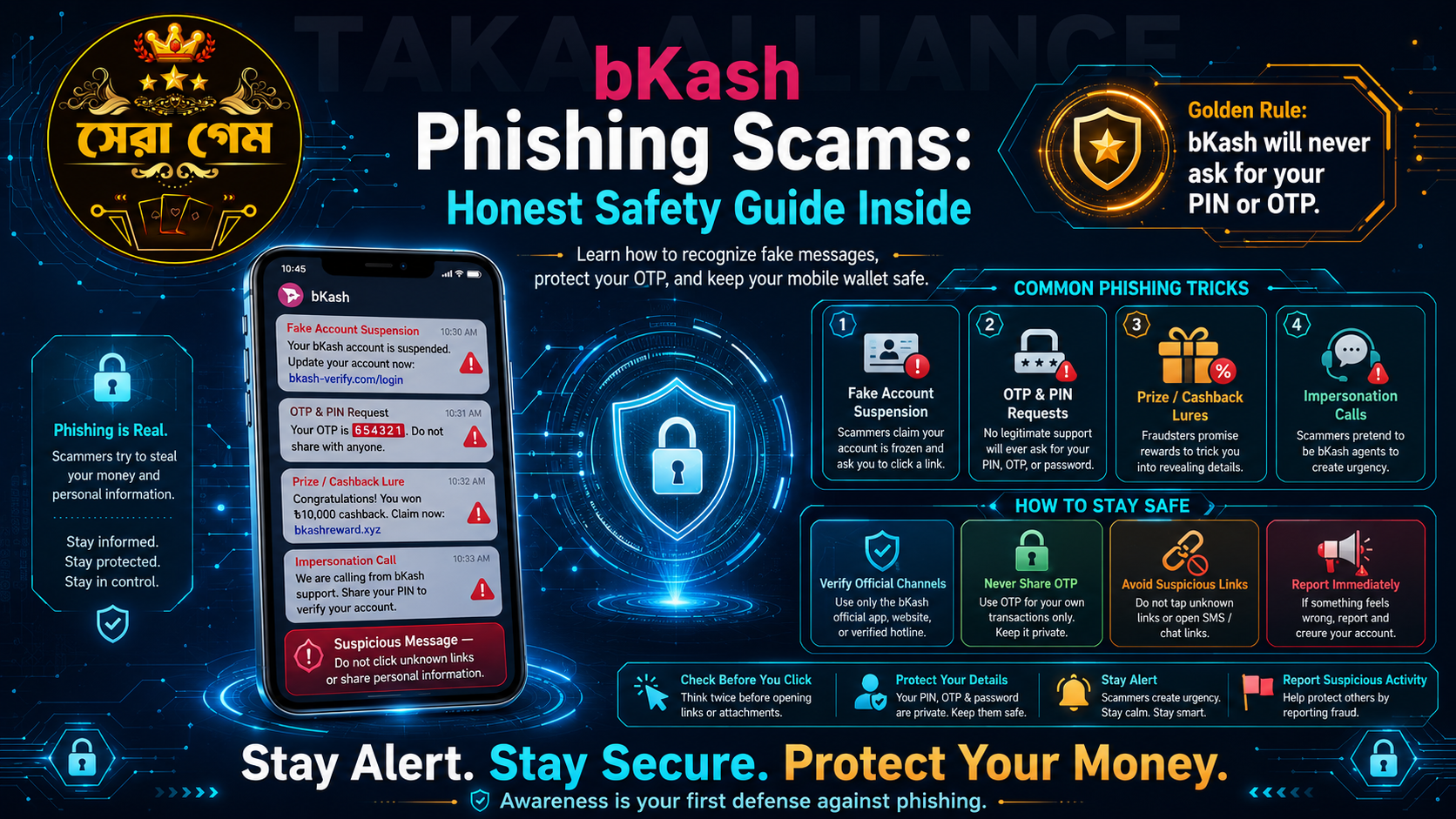
bKash phishing scams have quietly upgraded in 2026, and the advice most people still carry around no longer fits them. The fakes used to give themselves away with broken Bangla, a robotic voice, or an obviously wrong link. Now scammers use AI-generated voices, cloned numbers, and messages polished enough to pass for the real thing, all chasing the same prize they always wanted: your PIN, your one-time code, or your login. Security reporting describes a sharp reported rise in AI-generated phishing across 2026, including natural-sounding Bangla and English messages and calls that could be mistaken for a genuine agent. The good news is that the thing that beats almost all of it has not changed at all. bKash and Nagad never ask for your PIN or OTP, so the instant someone does, you already know what they are. This guide walks through how the new bKash phishing scams actually work, the exact trick behind AI voice calls and SMiShing texts, the signs that give them away even when they look flawless, and the calm steps to take if you have already handed something over.
Thursday evening, around twenty to eight. Rakib, 28, fixes phones at a shop near GEC Circle in Chittagong, so he is not the type you would expect to fall for a scam. His phone rang with a number that looked almost exactly like an official bKash line. The voice on the other end was calm, polite, professional, and it already knew his name and the last digits of his number. His account had been flagged for a security review, it said, and would be suspended within the hour unless he confirmed a code that was on its way. Right on cue, a text landed with a six-digit number. For a second or two Rakib’s thumb actually hovered over the keypad, ready to read it back. What stopped him was one line he remembered from a neighbour who had lost real money the same way: no agent ever needs your code. He hung up, opened the app himself, and found nothing wrong at all. This article is the full version of the conversation Rakib wishes he had heard before that call, so the next person does not have to rely on luck.
What Are the New bKash Phishing Scams in 2026?
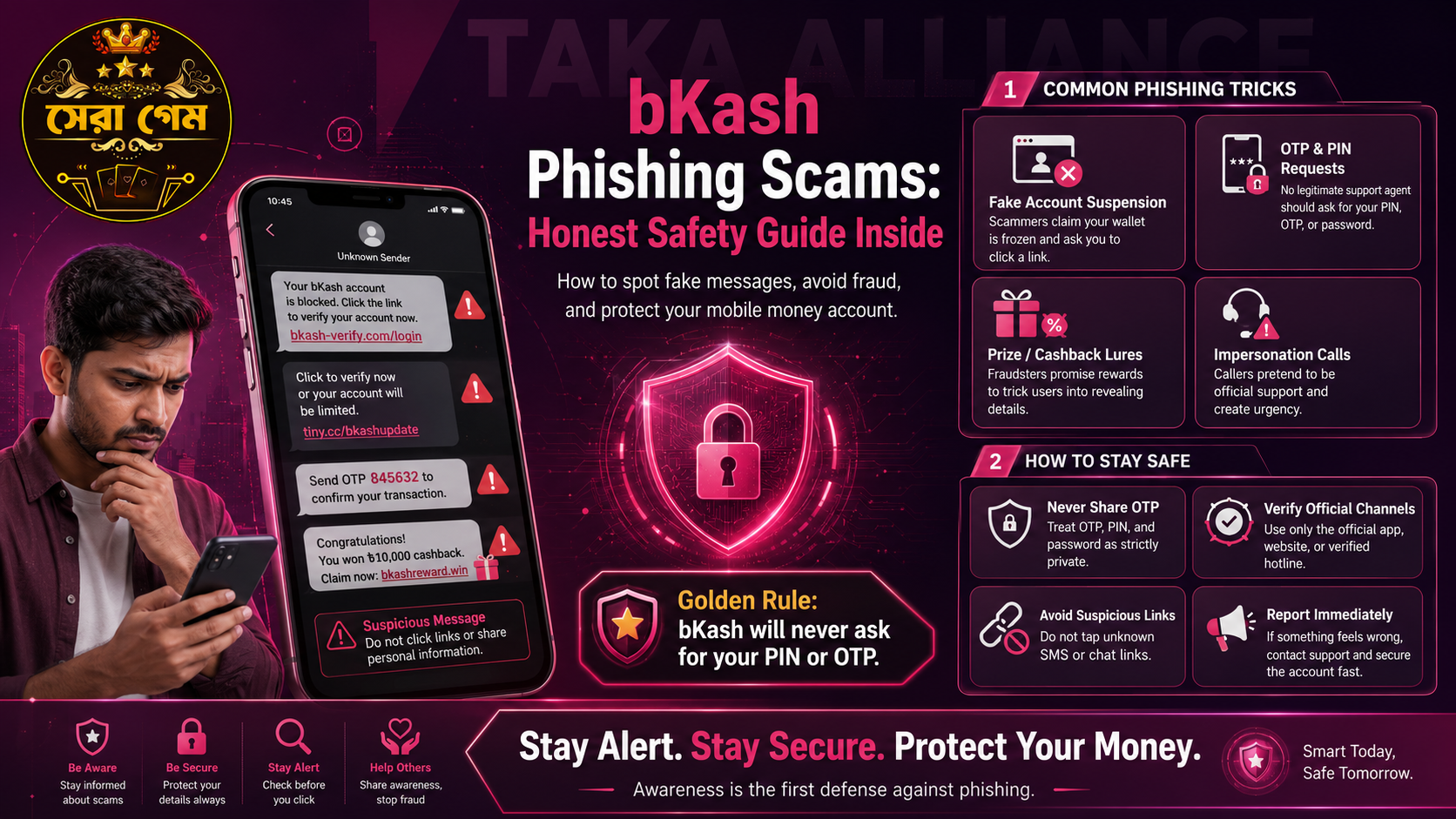
They are impersonation attacks that now sound real. The newest bKash phishing scams pretend to be bKash, Nagad, a bank, or even a regulator, and they push you to hand over a PIN, one-time code, or login. What changed in 2026 is the finish: AI voices and clean Bangla and English messages that pass for genuine contact, which is why the old “watch for bad grammar” tip no longer protects you.
That single shift is the whole problem. For years, the giveaway was clumsy wording, a strange link, or a stilted voice. Reporting now describes a sharp reported rise in AI-generated phishing across 2026, where the message reads naturally, the voice stays calm and professional, and the details feel personal. A caller can drop your name or the last digits of your number, because that kind of detail leaks constantly from breaches, social media, and earlier scams. None of the actual goal has moved; they still want your credentials. The costume is just much better than it used to be. So the defence has to stop relying on how convincing something looks and lean instead on a fixed rule about what no honest party will ever ask for. Our sibling guide on spotting impersonation and fake sites applies the same logic to fake login pages, and the tricks overlap almost completely.
This does not mean every message is now a scam. It means a polished look is no longer proof of anything. A text or call can be word-perfect and still be fraud, which is why the rest of this guide swaps “does this seem real” for checks that hold up even when the fake is.
How Do AI Voice Calls and Fake Agent Scams Actually Work?
They blend urgency, authority, and a code. A fake agent calls or texts saying your account is at risk, flagged, or about to be suspended, then offers to save it if you just confirm a one-time code or PIN. The AI voice keeps the caller sounding calm and official, and a genuine OTP text often arrives mid-call, because the scammer triggered it by trying to log in as you.
Once you see the mechanics, the whole thing deflates. The scammer almost always has your number already and is trying to get into your account or reset something tied to it. The system dutifully sends a real one-time code to your phone, exactly as it is designed to. The entire con is just talking you into reading that code aloud, or typing it into a fake screen, because the code is the last lock standing between them and your money. The urgency is staged on purpose, since panic stops people thinking. The authority is borrowed, since posing as bKash or a bank makes saying no feel rude or risky. And the personal touch is theatre, because knowing your name proves nothing about who is really calling. The instant you realise the code in your hand is the exact key they are missing, the script collapses. No real agent needs it, because the actual company can already see and manage your account without you reading anything back.
This is also why putting the phone down is never rude and never dangerous. A real institution will not punish you for checking through official channels, and a scammer can do precisely nothing without your help. When a call starts squeezing you about a code, the squeeze itself is the tell.
Where Do Scammers Get Your Name and Number in the First Place?
From everywhere your details have ever travelled. The personal touches in a bKash phishing scam, your name, the last digits of your number, sometimes even where you bank, come from leaked databases, public social media profiles, old scam lists that get traded around, and the countless forms you fill at shops, deliveries and sign-ups. None of it requires the scammer to know you at all.
This is the part people find hardest to believe, because it feels personal when a stranger says your name down the phone. It is not. There is a steady, low-level market in exactly this kind of information, and a fraudster running hundreds of calls a day simply buys or scrapes a list and dials through it. The details are a prop to lower your guard, nothing more. A caller knowing your name proves they got hold of a record somewhere; it says nothing about whether they actually work for bKash, and it never will.
You cannot fully scrub yourself from these lists, but you can shrink your exposure. Share your number sparingly, think twice before posting full personal details publicly, and never treat “they knew my name” as a reason to trust a call. Once you stop reading personalisation as proof, the scammer’s best opening line loses all its weight, and the conversation comes right back to the only thing that matters: are they asking for a code or a PIN.
What Are the Most Common Scam Types Targeting Bangladesh Users?
They come in a handful of recognisable shapes. The bKash phishing scams reaching Bangladesh users most often are fake agent calls, SMiShing texts carrying a link or code, social media impersonation, and the classic “you won” or “send money to get money” hooks. Different costumes, same ending: getting you to give up a credential or send a transfer you will never see again.
Recognising the pattern beats memorising every version, because the wrapper changes constantly while the aim never does. The table below lines up the common types against the trick each leans on and the single check that kills it, so you can clock a scam by its shape even when the wording is brand new. Read it as a field guide, not a complete list, since fraudsters keep inventing fresh packaging around the same tired goals.
| Scam type | How it reaches you | The trick | The check that stops it |
|---|---|---|---|
| Fake agent call | Voice call, often a spoofed or cloned number | Urgent “account flagged”, asks you to confirm a code or PIN | No agent ever needs your OTP or PIN. Hang up, call official support yourself. |
| SMiShing text | SMS with a link or a code | Fake login link or “verify now” message | Never tap links in payment texts. Open the official app directly. |
| Social media impersonation | Fake bKash or “agent” page or profile | Builds trust, then asks for details or a “fee” | Real help only comes through official channels, never a DM. |
| Prize or cashback scam | Call, SMS, or message | “You won” or “send money to unlock a bigger amount” | You never pay to receive money. Real prizes do not need your PIN. |
| Fake “wrong transfer” scam | Call after a real or claimed transfer | Says money came to you by mistake, asks you to send it back | Check your own balance in the app first. Do not act on their word. |
If a call or message matches any row above, you do not need to work out whether this particular one is genuine. The check in the last column works either way. For scams that steer you onto a fake website rather than a phone call, our seven red flags for fake sites shows how to catch a cloned page before you type a single thing into it.
How Can You Spot a bKash Phishing Scam Before You Lose Money?
Watch for pressure paired with a request for a secret. Nearly every bKash phishing scam carries the same three marks: it manufactures urgency, it claims authority, and it asks for something no honest party ever needs, like your PIN or one-time code. Anything with all three is fraud, however smooth it sounds and whoever’s name it borrows.
A few plain habits turn that into real protection. Treat any out-of-the-blue contact about your account as unverified until you confirm it yourself, through the official app or a published support number, never the number or link the message handed you. Refuse to read codes aloud or punch them into a screen you did not open, because that one-time code is the single thing between a scammer and your balance. Slow down the moment you feel rushed, since urgency is their main weapon and a genuine institution will give you room to breathe. And stay unimpressed by personal details, because a name or a few digits is cheap information that proves nothing about who is calling. These checks cost a few seconds and hold up even against a flawless AI voice, which is the entire point in 2026. If you want to understand how genuine bKash and Nagad monitoring really works, so you can tell the real system apart from a fake “security review” call, our AI monitoring breakdown lays it out.
If there is one line worth carrying around, it is the one that saved Rakib: no real agent ever needs your PIN or OTP. Hold that firmly and the rest of the scam, however convincing, has nowhere left to go. Everything else here is just backup for that single habit.
What Should You Do If You Already Shared a PIN or OTP?
Move fast, and move in order. If you have already given up a PIN or one-time code, change your PIN straight away through the official app if you can still get in, contact official bKash or Nagad support immediately, and report the fraud to the authorities. Speed limits the damage, and moving quickly usually matters more than moving perfectly.
Here is the sequence worth following. First, if you can still log in, change your PIN at once and scan for any transfers you did not make. Second, reach the provider directly through the official channels published by bKash or Nagad, never a number the scammer gave you, and tell them exactly what you shared so they can lock or secure the account. Third, report it to the Bangladesh Cyber Crime Unit, which handles online fraud, and keep your screenshots, numbers and messages as evidence. If money moved through your bank as well, call the bank, and remember that Bangladesh Bank is the regulator over the formal system. Skip the shame, too; these scams are built by professionals to fool careful people, and reporting quickly protects others as much as it protects you.
Be honest with yourself about recovery, though. Once a transfer has left your account, getting it back is not guaranteed, which is exactly why prevention carries so much weight. What fast reporting can do is sometimes break a chain of transfers before it finishes, lock the account against further loss, and feed the fraud data that helps shut these networks down. Our account security and recovery playbook covers these steps in more depth, and our payment errors playbook helps you tell a real technical glitch apart from a scammer’s pretext.
How Can Bangladesh Families Protect the Most Vulnerable Users?
Say the one rule out loud, and say it often. The most effective protection a family has is making sure everyone, especially older relatives and first-time users, knows that no agent ever needs their PIN or OTP. Scammers go hunting for the least confident person in the house, so one clearly understood rule, repeated until it sticks, ends up shielding everybody.
A little effort here pays off out of all proportion. Talk the common scams through at home in plain Bangla, using the shapes in this guide, so a relative recognises a fake agent call by its pattern before it ever lands on them. Make it normal for anyone unsure to pause and ring a trusted family member before acting on an urgent money message, because a thirty-second call to a daughter or son has quietly stopped countless transfers. Set the expectation that hanging up and checking independently is always the right move and never rude. And keep the tone calm rather than frightening, since fear just pushes a nervous user to avoid mobile money altogether, when what you actually want is confident, safe use. The same impersonation tricks turn up across every kind of financial scam, not only mobile money, which is why our phishing safety checks are worth sharing with anyone who banks or pays on a phone.
These scams run on isolation and panic, and family conversation cuts through both. Someone who knows the one rule, feels free to pause, and has a person to ask is far harder to fool than any scammer is counting on. You can follow how scam tactics and the digital rules around them keep changing through our latest Bangladesh digital and safety news hub, and the full set of services we have reviewed sits in the TAKA ALLIANCE verified platform directory.
Frequently Asked Questions
Will bKash or Nagad ever ask for my PIN or OTP?
No. Neither bKash nor Nagad, nor any bank or regulator, will ever ask you to share your PIN or one-time code by call, SMS or message. They do not need it to manage your account. Anyone who asks is a scammer, no matter how official the contact looks or sounds.
How do scammers make the call look like an official bKash number?
They use number spoofing and cloning, which can make a call show a number that resembles an official line. The display is not proof of identity. Treat any unexpected account call as unverified, hang up, and call the official support number you find yourself inside the app, never one the caller offers.
Why did a real OTP text arrive during the scam call?
Because the scammer triggered it by trying to log in or reset something as you. The code is genuine, but reading it back hands them the final key to your account. A real code landing during a pressuring call is itself a strong warning sign, not a reason to trust whoever is on the line.
Are AI voice scams really targeting Bangladesh users in 2026?
Security reporting describes a sharp reported rise in AI-generated phishing across 2026, including realistic voices and clean Bangla and English messages. Treat the trend as directional rather than an exact official count. Either way the response is identical: never share a code or PIN with anyone who contacts you.
What is SMiShing and how is it different from a normal scam text?
SMiShing is phishing by SMS, often using a cloned or familiar-looking number plus a link or code. It works because people trust texts more than emails. The safe habit is simple: never tap links inside payment-related texts, and instead open the official app directly to check whatever the message claims.
What should I do first if I shared my code with a scammer?
If you can still log in, change your PIN immediately and check for transfers you did not make. Then contact official bKash or Nagad support through their published channels, and report the fraud to the Bangladesh Cyber Crime Unit. Acting fast can limit the damage, even though recovering a completed transfer is never guaranteed.
Can I get my money back after a phishing scam?
Sometimes, but not reliably once a transfer has left your account. Fast reporting to the provider and the Cyber Crime Unit gives the best shot at stopping further transfers and securing the account. Prevention matters most, which is why the one rule about never sharing a code is the real protection.
How do I protect an older relative who is not confident with phones?
Teach them one clear rule out loud and keep repeating it: no agent ever needs your PIN or code. Encourage them to pause and call a trusted family member before acting on any urgent money message, and reassure them that hanging up to check is always correct. Calm, repeated guidance protects nervous users best.
See our latest Bangladesh digital and safety news hub for ongoing scam coverage, and our account security and recovery playbook if you need the full step-by-step response.
Last updated: June 2026
Reviewed by Michael Max.
About the Author