


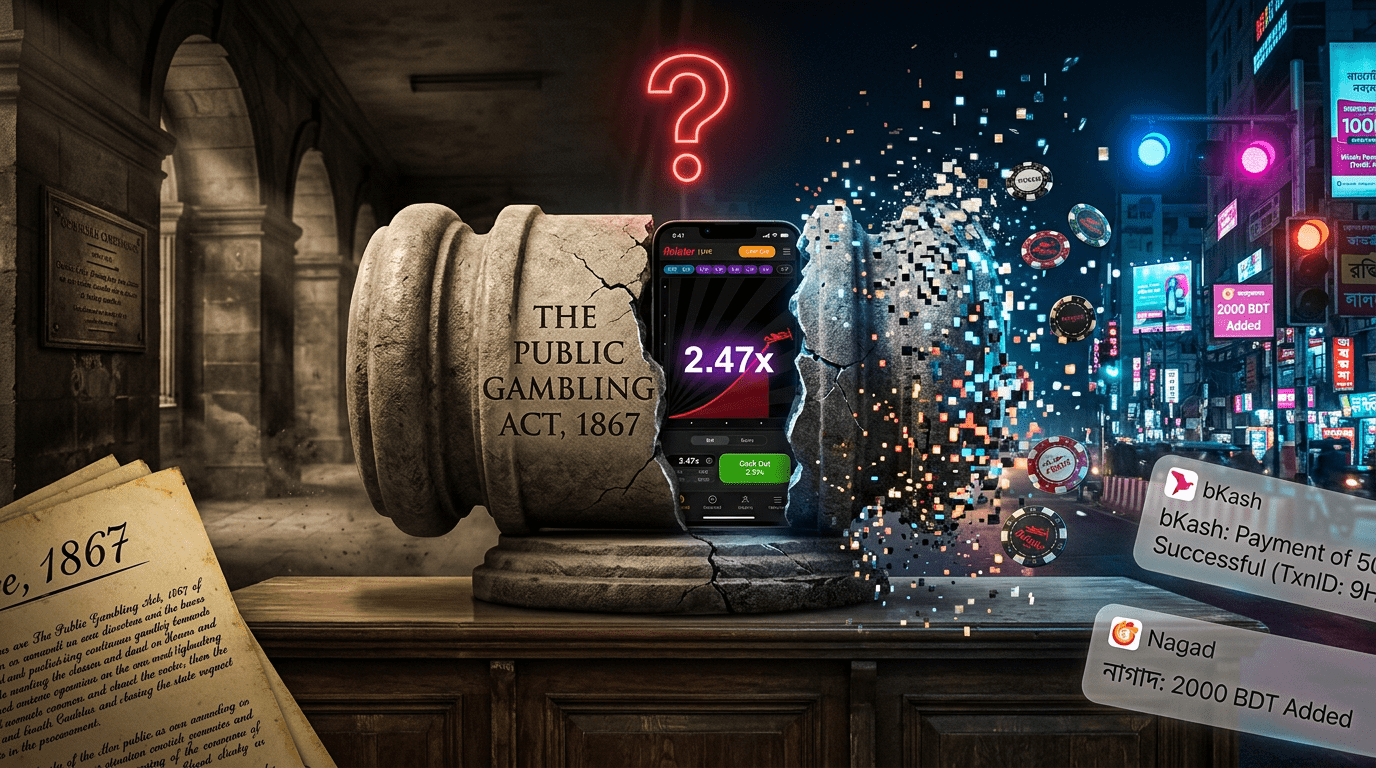
The 159-year gap — Bangladesh's 1867 Public Gambling Act was never updated for online casinos, smartphones, bKash deposits, or Aviator crash games, creating a legal gray area for millions of players
Bangladesh Casino Legal Status 2026 — Everything You Pretend to Know But Actually Don’t
Let us start with the conversation that happens at every cha stall in Dhaka at least once a week. Someone pulls out
their phone, shows their friend a 12,000 BDT Aviator win, and the friend immediately asks: “But bro, isn’t this
illegal?”
The person with the win pauses. They do not actually know the answer. They mumble something about “it’s online so it’s
different” or “millions of people do it” or “my cousin’s friend works in IT and he says it’s fine.”
The truth is, nobody at that cha stall — and almost nobody in Bangladesh — can give you a clear, accurate answer about
the legal status of online casino gaming in this country.
That is because the answer is genuinely complicated. It is not a simple “legal” or “illegal.” It lives in a gray zone
that has existed for decades and shows no signs of resolving anytime soon.
This guide will walk you through exactly what that gray zone looks like in 2026, what the actual laws say, what happens
in practice, what risks exist, and how to make informed decisions about your own behavior.
We are not lawyers. This is not legal advice. This is journalism — researching and presenting the facts so you can
understand the landscape you are operating in. What you do with that understanding is your decision.

Act and knows exactly where online casino gaming stands in Bangladesh 2026
The Law That Everyone References But Nobody Has Actually Read
The primary law governing gambling in Bangladesh is the Public Gambling Act of
1867. Yes, 1867. This law was written during British colonial rule — 104 years before Bangladesh even
existed as a country. It was originally designed for the Indian subcontinent and was inherited by East Pakistan, which
then became Bangladesh after the Liberation War of 1971.
What the 1867 Act Actually Says
The Act is remarkably short by modern standards. Its key provisions:
- Section 3: Penalty for owning or keeping a “common gaming house.” Fine of 200 rupees or
imprisonment up to 3 months. - Section 4: Penalty for being found in a gaming house. Fine of 100 rupees or imprisonment up to 1
month. - Section 11: Exempts “games of skill” from the Act. Horse racing is specifically mentioned as an
exempt activity. - Section 12: The Act does not apply to “games played in private dwellings” — meaning private poker
games, card games at home, and similar activities are technically not covered.
That is essentially it. A law written in 1867 to address physical gambling dens — “common gaming houses” — in colonial
India. There is no mention of:
- The internet (did not exist)
- Mobile phones (did not exist)
- Online casinos (did not exist)
- Mobile payment systems like bKash (did not exist)
- Cryptocurrency (did not exist)
- Crash games, slots, live streaming, or any digital technology
The law was written to shut down physical gambling dens in Calcutta and Dhaka. It was never updated to address the
reality of a Bangladeshi player sitting on their bed in Mirpur, using a Realme C55 on Banglalink 4G, depositing via
Nagad, playing Aviator on a platform hosted on servers in Curaçao.
The 159-Year Gap
Between 1867 and 2026 — 159 years — Bangladesh has not passed a single comprehensive law specifically addressing online
gambling. There have been discussions. There have been proposals. There have been committee formations. But no
legislation has been enacted that clearly defines the legal status of online casino gaming for individual players.
This gap is not unique to Bangladesh. Many countries in South and Southeast Asia operate under similar colonial-era
gambling laws that predate the internet by over a century. India, Pakistan, Sri Lanka, and Myanmar all face comparable
legal ambiguities around online gambling.
What “Gray Area” Actually Means in Practice
When people say online gambling in Bangladesh exists in a “gray area,” they mean something specific. Let us break down
exactly what that gray area looks like in practice in 2026.
What IS Clearly Illegal
- Operating a physical casino or gambling house in Bangladesh. If you open a casino with tables and
slot machines in Dhaka, you will be arrested. This is unambiguous under the 1867 Act and subsequent enforcement. - Running an online gambling operation FROM Bangladesh. If you set up servers in Bangladesh and
operate an online casino business from Bangladeshi soil, authorities can and do take action. - Promoting gambling to minors. This falls under child protection laws separate from the gambling
act. - Using gambling to launder money. Money laundering is illegal regardless of the source, and
gambling-related laundering is prosecuted under financial crime laws.
What IS Clearly Legal
- Horse racing and betting on horse racing. Explicitly exempted under Section 11 of the 1867 Act.
The Royal Dhaka Turf Club operated legally for decades. - Government lotteries. The Bangladesh government itself operates lottery systems. The irony of the
government running gambling while prohibiting private gambling is not lost on anyone. - Games of skill. Fantasy sports, chess competitions with prizes, and similar skill-based
activities are generally considered legal under the “games of skill” exemption. The line between skill and chance,
however, is heavily debated.
The Gray Zone — Where Online Casino Players Live
This is where it gets complicated. Online casino gaming — the thing millions of Bangladeshis do daily — exists in a
space that the law does not clearly address:
The platform is not in Bangladesh. TAKA ALLIANCE platforms and similar services
operate from jurisdictions like Curaçao, Malta, Gibraltar, or the Philippines — countries where online gambling is
licensed and regulated. The servers are not in Bangladesh. The company is not registered in Bangladesh. The license is
not from Bangladesh.
The player is in Bangladesh. You are a Bangladeshi citizen, sitting in Bangladesh, accessing the
platform through your phone. The 1867 Act addresses being in a “gaming house” — but is your bedroom a gaming house? Is
your phone a gaming house? The law does not answer this because the law was written when gaming houses had physical
doors you walked through.
The money moves through Bangladesh. Your bKash account, your Nagad wallet, your Rocket balance — these
are Bangladeshi financial services. When you deposit 1,000 BDT to a gaming platform through bKash, the money leaves your
Bangladeshi wallet and goes to a payment processor.
The processor sends it to the platform’s account in another jurisdiction. When you withdraw, the reverse happens. These
transactions occur on Bangladeshi financial infrastructure.
No player has been prosecuted for playing online. As of April 2026, there are no reported cases of
individual Bangladeshi players being arrested, charged, or prosecuted specifically for playing on international online
casino platforms from their personal devices. This does not mean it is legal. It means it is not enforced at the
individual player level.
Why the Government Has Not Resolved the Gray Area
This is a question worth asking: if millions of Bangladeshis gamble online, why has the government not either legalized
and taxed it, or explicitly criminalized and enforced it?
The answer involves multiple competing pressures:
1. Revenue Considerations
The global online gambling market is worth over $100 billion annually. India’s online gaming market alone is projected
at $7-8 billion by 2026. Bangladesh’s share — even at a fraction of India’s — represents significant economic activity.
Some government officials recognize that regulation and taxation could generate substantial revenue. But the political
cost of openly supporting gambling legalization in a Muslim-majority country is enormous.
2. Religious and Cultural Sensitivity
Bangladesh is approximately 90% Muslim. Islam prohibits gambling (maysir/qimar) in the Quran. Any government that moves
toward legalization faces intense opposition from religious leaders, conservative political parties, and a significant
portion of the population. Even discussing gambling regulation is politically toxic for most Bangladeshi politicians.
At the same time, millions of Bangladeshi Muslims gamble regularly — on cricket, on casino games, on lotteries (yes, the
government-run ones too). The gap between religious prohibition and actual behavior is vast, but acknowledging this gap
publicly is something no politician wants to do.
3. Technical Enforcement Challenges
Even if the government wanted to crack down on online gambling, the technical challenges are immense:
- VPN usage is widespread. Block a gambling site and players use VPNs to access it.
- Platforms constantly change domains. Block one URL and the platform appears on another within
hours. - Mobile payments are difficult to monitor at scale. bKash processes millions of transactions
daily. Identifying which ones are gambling-related requires surveillance capabilities that raise privacy concerns. - Cryptocurrency is nearly impossible to track. Players using USDT, BTC, or ETH for deposits bypass
the mobile money system entirely. - International jurisdiction limits. Bangladesh has no authority over companies operating from
Curaçao or Malta.
4. Priority of Resources
Bangladesh law enforcement has limited resources dealing with far more pressing issues — political violence, narcotics
trafficking, human trafficking, corruption, and cybercrime targeting financial institutions. Prosecuting individual
citizens for playing Aviator on their phones is simply not a priority when resources are stretched thin addressing
serious threats to public safety.
5. The Employment Argument
The online gaming ecosystem in Bangladesh — including platform agents, payment processors, customer support teams,
content creators, and affiliate marketers — employs thousands of people, many of them young and tech-savvy. Cracking
down would eliminate these jobs without providing alternatives. This is a pragmatic consideration that influences policy
inaction.
What Has Actually Happened — Enforcement Actions in Bangladesh
While individual players have not been prosecuted, there have been enforcement actions in the broader gambling
ecosystem. Understanding these helps you assess your own risk accurately.
Actions Against Physical Operations
Bangladesh law enforcement regularly raids physical gambling dens — typically card games and dice games operating in
basements, hotel rooms, or rented apartments. These raids are well-publicized and often result in arrests, fines, and
confiscation of cash. This enforcement is consistent and ongoing. If you are physically present in a gambling house, you
are at real risk of arrest.
Actions Against Online Operations Based in Bangladesh
There have been cases where individuals operating online gambling platforms FROM Bangladesh have been arrested. This
typically involves people running local agent networks, managing payment channels for offshore platforms, or operating
unauthorized gambling apps. The enforcement targets the operators, not the players.
Website Blocks
The Bangladesh Telecommunication Regulatory Commission
(BTRC) has ordered ISPs to block access to specific gambling websites at various times. These blocks are often
temporary, inconsistently enforced, and easily bypassed with VPNs. The blocks target domains, not users — your ISP may
block a URL, but nobody is monitoring whether you accessed it before the block.
Payment Channel Disruptions
Occasionally, specific payment channels used for gambling deposits are disrupted. bKash and Nagad have terms of service
that technically prohibit gambling transactions. In practice, the volume of transactions makes individual monitoring
impractical, and gaming-related payments continue to process through these platforms without issue for the vast majority
of users.
What Has NOT Happened
- No individual player has been publicly prosecuted for playing on an international online casino from their
personal device - No new legislation specifically addressing online gambling has been passed
- No systematic monitoring of individual gambling activity through mobile payments has been implemented
- No cryptocurrency gambling transactions have been traced and prosecuted
The Risk Assessment — What Players Should Actually Worry About
Let us be honest about risks rather than either fear-mongering or pretending everything is perfectly safe.
Very Low Risk
- Being arrested for playing on an international platform from your phone. While theoretically
possible under broad interpretation of existing law, there is no precedent and no mechanism for enforcement at this
scale. Risk level: very low. - Your bKash/Nagad account being frozen specifically for gambling. While ToS technically prohibit
it, the practical reality is that millions of gaming transactions process daily without intervention. Risk level:
very low.
Low-Medium Risk
- Social consequences. If your employer, family, or community discovers you gamble, the social
impact can be significant in Bangladesh’s conservative culture. This is not a legal risk but a practical one. Risk
level: depends on your personal situation. - Tax implications. Bangladesh does not currently tax gambling winnings from online platforms
(there is no framework for it). However, large unexplained deposits in your bank account or mobile wallet could
theoretically attract attention from tax authorities or anti-money-laundering teams. Risk level: low for typical
amounts, medium for very large winnings.
Medium Risk
- Platform reliability. Because online gambling operates in a gray area, there is no local
regulatory body to complain to if a platform does not pay you. This is why choosing platforms with international
licenses (Curaçao, Malta, etc.) and established reputations matters. TAKA ALLIANCE platforms are licensed
internationally, which provides a layer of protection — but not Bangladeshi legal protection. - Scam platforms. The gray area attracts both legitimate operators and scammers. Fake platforms
that take deposits and never process withdrawals are a real risk. Always access platforms through verified sources.
Never trust random Telegram or Facebook links.
High Risk
- Operating a gambling business. If you are thinking of becoming an agent, running a local payment
network for gambling, or operating a platform — the risk of legal action is real and significant. Enforcement
targets operators, not players. - Financial overexposure. The biggest actual risk for most players is not legal — it is financial.
Gambling more than you can afford, chasing losses, borrowing to gamble. See our responsible gaming guide for tools to manage this
risk.
How Other Countries Handle It — Comparison
Bangladesh’s gray area is not unique. Looking at how neighboring countries approach online gambling provides useful
context.
| Country | Online Casino Status | Individual Player Enforcement | Notable |
|---|---|---|---|
| India | Gray area (state-by-state) | No enforcement against individuals | Some states (Goa, Sikkim) have legalized; most are gray |
| Pakistan | Illegal on paper | No enforcement against online players | Similar colonial-era law, similar non-enforcement |
| Philippines | Legal (PAGCOR licensed) | N/A — regulated market | Major hub for offshore gambling platforms |
| Sri Lanka | Illegal on paper | Minimal enforcement | Casino tourism in Colombo exists alongside prohibition |
| Myanmar | Illegal but widespread | Selective enforcement | Border casinos serve regional players |
| Thailand | Moving toward legalization (2025-2026) | Historically enforced, now relaxing | Major policy shift underway |
| Japan | Partially legal (integrated resorts) | N/A for legal operations | Strict regulation model |
| UK | Fully legal and regulated | N/A — regulated market | UKGC is the gold standard of regulation |
The pattern across South Asia is consistent: colonial-era laws prohibit physical gambling, no modern legislation
addresses online gambling, and enforcement focuses on operators rather than individual players. Bangladesh fits this
regional pattern precisely.
The Future — What Might Change
Several factors could shift Bangladesh’s gray area in either direction:
Toward Legalization/Regulation
- Revenue pressure. As Bangladesh’s economy grows and public spending demands increase, the tax
revenue potential of regulated online gambling becomes harder to ignore. India’s moves toward state-level regulation
may influence Bangladesh’s thinking. - Thailand precedent. Thailand’s 2025-2026 movement toward casino legalization is being watched
across Asia. If Thailand’s regulated model proves successful (generating revenue without social catastrophe), it
could encourage similar moves in Bangladesh. - Digital economy growth. Bangladesh’s digital economy is expanding rapidly. As mobile payments,
fintech, and digital services become central to the economy, the government may find it necessary to regulate
digital gambling rather than pretend it does not exist. - Youth demographics. Bangladesh has a young population increasingly comfortable with digital
entertainment, online payments, and global platforms. Political parties that want to engage young voters may
eventually address online gambling pragmatically rather than through prohibition.
Toward Stricter Enforcement
- Religious pressure. Conservative religious movements could push for explicit criminalization of
online gambling, particularly if problem gambling becomes a visible social issue. - Financial regulation. If Bangladesh’s central bank decides to crack down on mobile money being
used for gambling, it could disrupt payment channels significantly. This is probably the most realistic enforcement
scenario — not arresting players, but blocking their ability to deposit. - International pressure. Global anti-money-laundering initiatives could push Bangladesh to address
the flow of gambling-related funds through its financial system. - Problem gambling crisis. If gambling addiction becomes a public health crisis (and the growth
rate of mobile gambling in Bangladesh makes this plausible), political pressure for restrictive legislation could
build.
Most Likely Scenario
The most likely scenario for the next 3-5 years is continued gray area with incremental changes.
Bangladesh will probably not legalize online gambling (too politically costly) and will probably not effectively ban it
(too technically difficult and economically counterproductive).
The gray area will persist, with occasional enforcement actions against operators and periodic website blocks, while
individual players continue to access international platforms without meaningful legal consequences.
Practical Guidance for Bangladeshi Players in 2026
Given the legal landscape described above, here is practical guidance for players who choose to gamble online in
Bangladesh:
1. Use Platforms with International Licenses
Since Bangladesh does not regulate online gambling, the only regulatory protection available comes from international
licenses. TAKA ALLIANCE platforms are licensed
in established jurisdictions (Curaçao, etc.), which provides oversight that unlicensed platforms do not have. A licensed
platform has obligations to pay winners, protect player data, and maintain fair games. An unlicensed platform has no
obligations to anyone.
2. Keep Gambling Amounts Reasonable
Large, unexplained financial flows attract attention — from tax authorities, from financial institutions, from family
members. Keeping your gambling within your means (see our responsible gaming guide) is not just good financial
practice — it is also practical risk management. A player depositing 500 BDT per week is invisible. A player moving
500,000 BDT per month raises questions.
3. Understand That “Gray Area” Means Uncertainty, Not Safety
The gray area protects nobody explicitly. It simply means the law has not caught up with technology. This could change.
A new law, a new court ruling, a new enforcement policy — any of these could shift the landscape. Play with awareness
that the rules could change, even if they have not changed yet.
4. Protect Your Identity
Use legitimate platforms that protect your data. Do not share your gaming activity on public social media (screenshots
of wins attract both scammers and attention). Be thoughtful about who knows you gamble.
5. Never Operate as an Agent or Intermediary
The legal risk for operators is significantly higher than for players. If someone offers you money to be a “local agent”
for a gambling platform — recruiting players, processing local payments, running a Telegram group — you are stepping
from the relatively safe player zone into the genuinely risky operator zone. Decline.
6. Keep Records
Maintain your own records of deposits and withdrawals. If you ever need to explain your financial activity (to a bank,
to tax authorities, to family), having clear records is better than having nothing.
7. Stay Informed
Legal landscapes change. Follow developments in Bangladesh gambling regulation through reliable news sources. If new
legislation is proposed or enforcement patterns shift, you want to know early rather than being surprised.
The Elephant in the Room — Government Lotteries
We cannot write this guide without addressing the enormous irony at its center. The Bangladesh government — the same
government under whose laws gambling is technically prohibited — operates its own lottery systems. Government-approved
lottery tickets are sold openly at shops across the country. Lottery results are published in newspapers. Winners are
celebrated publicly.
A lottery is gambling. You pay money. The outcome is determined by chance. You either win or lose. There is a house edge
(lottery house edges are typically 40-50%, dramatically worse than any casino game). By any reasonable definition, a
government lottery is a gambling product.
The legal distinction — that government lotteries are specifically authorized while private gambling is not — is a
policy choice, not a moral distinction. The government has decided that it can offer gambling to citizens but private
companies cannot. Whether this distinction makes sense is a question every Bangladeshi citizen can answer for
themselves.
This is not an argument that private gambling should be legal because government lotteries exist. It is an observation
that the legal framework around gambling in Bangladesh contains internal contradictions that undermine its moral
authority. These contradictions are part of why the gray area persists — the government cannot credibly claim gambling
is harmful while simultaneously operating gambling products.
What International Licensing Actually Means for Bangladeshi Players
Since Bangladesh does not regulate online gambling, the concept of “licensing” is often misunderstood by players. Here
is what it actually means when a platform says it is “licensed in Curaçao” or “Malta-regulated.”
Curaçao eGaming License
The most common license for platforms serving the Asian market. Curaçao is a Caribbean island that is part of the
Kingdom of the Netherlands. Its gaming license requires operators to maintain fair game RTP (Return to Player)
percentages, keep player funds in segregated accounts separate from operational funds, implement responsible gaming
tools, process withdrawals within stated timeframes, and submit to regulatory audits.
What it means for you: a Curaçao-licensed platform has legal obligations to pay your winnings. If they refuse, you can
file a complaint with the Curaçao Gaming Control Board. This is not Bangladeshi legal protection — but it is something,
which is better than nothing.
Malta Gaming Authority (MGA)
The strictest mainstream gambling license. MGA-licensed platforms undergo rigorous auditing, must maintain substantial
financial reserves, and face severe penalties for player mistreatment. Fewer Asian-facing platforms hold MGA licenses
due to the cost and compliance requirements. If a platform has an MGA license, it is generally considered the most
trustworthy tier.
No License
Some platforms operate without any license at all. These are the highest risk for players. Without regulatory oversight,
there is no mechanism to enforce fair play, no guarantee of withdrawals, and no recourse if you are cheated. In
Bangladesh’s gray area, where you have no local legal protection, the international license is your only safety net. Do
not play on unlicensed platforms.
TAKA ALLIANCE platforms operate under
international licensing, which — while imperfect — provides a regulatory framework that protects player interests in
ways that unlicensed operations cannot. All 20 platforms are accessible through takaalliance.ai, with independent testing data on TAKA ALLIANCE UK.
Frequently Asked Questions
Is online casino gaming illegal in Bangladesh?
The Public Gambling Act of 1867 prohibits operating gambling houses and being present in them. It does not specifically
address online gambling. Playing on international platforms from your phone exists in a legal gray area — not explicitly
legal, not explicitly illegal, and not enforced against individual players as of 2026.
Can I be arrested for playing on TAKA ALLIANCE platforms?
While theoretically possible under broad interpretation of existing law, there are no reported cases of individual
players being arrested for playing on international online casino platforms from their personal devices. Enforcement
targets operators, not players.
Is bKash/Nagad gambling deposit safe?
bKash and Nagad terms of service technically prohibit gambling transactions. In practice, millions of gaming-related
transactions process daily without intervention. The risk of account action specifically for gambling deposits is very
low but not zero.
What happens if I win a large amount?
Your winnings will be sent to your bKash, Nagad, or crypto wallet as usual. Bangladesh does not currently tax gambling
winnings (there is no framework for it). However, very large amounts appearing suddenly in your financial accounts could
theoretically attract attention from anti-money-laundering systems.
Is cryptocurrency gambling safer legally?
Cryptocurrency adds a layer of privacy to gambling transactions since crypto wallets are not directly linked to your
national identity the way bKash is. However, cryptocurrency itself exists in its own legal gray area in Bangladesh.
Using crypto does not make gambling legal — it simply makes transactions harder to trace.
Can the government block gambling websites?
Yes, the BTRC can and has ordered ISPs to block specific gambling URLs. These blocks are inconsistently enforced and
easily bypassed with VPNs or DNS changes. Website blocks target domains, not users.
Is sports betting legal in Bangladesh?
Sports betting falls under the same gray area as casino gaming. Horse racing betting is the only specifically exempted
form of gambling. Cricket betting, football betting, and other sports betting exist in the same unaddressed legal space
as online casino gaming.
What should I do if the law changes?
Stay informed through reliable news sources. If new legislation is proposed, understand its scope — does it target
players, operators, or both? Does it include transition periods? Most regulatory changes include notice periods before
enforcement begins. Do not panic based on rumors — wait for verified information from official government sources or
credible media.
Is this article legal advice?
No. This article is journalism — presenting facts and context about the legal landscape. It is not legal advice. If you
need legal advice about gambling in Bangladesh, consult a licensed Bangladeshi attorney who specializes in technology or
entertainment law.
This guide is part of the TAKA ALLIANCE Guides series. For platform
reviews, visit our complete TAKA ALLIANCE
review. For responsible gaming tools, see our responsible gaming guide. For payment methods, see our
bKash guide and Nagad guide.
Last updated: April 2026
About the Author