



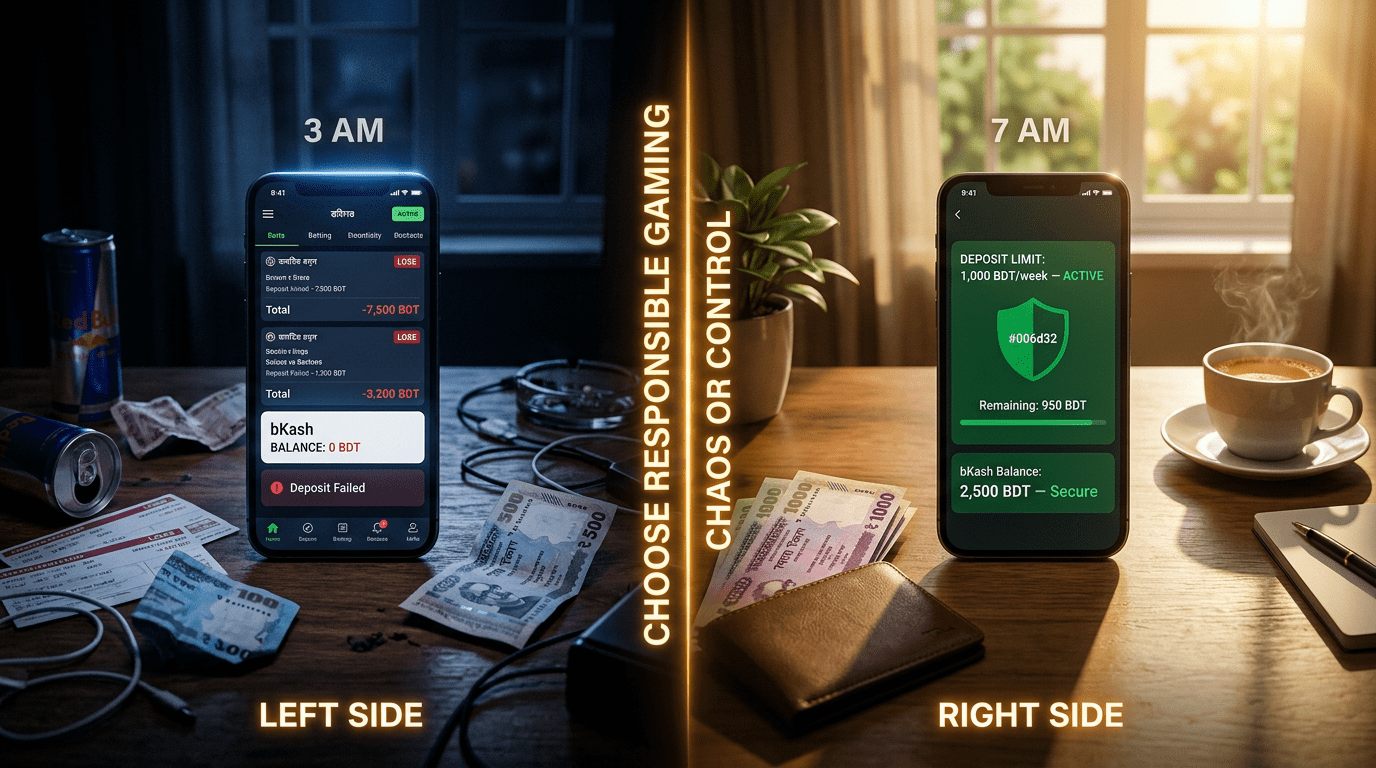
The choice every Bangladesh player faces — chaos of chasing losses at 3 AM or the control of setting deposit limits and walking away a winner
Responsible Gaming in Bangladesh — The Guide You Need to Read Before You Need It
Nobody reads responsible gaming guides before they need one. That is the problem. You read this kind of guide after
something has already gone wrong — after you have chased losses at 3 AM and deposited your rent money, after your wife
found your bKash transaction history and the room went silent, after you borrowed 5,000 BDT from your cousin “for an
emergency” and spent it on Gates of Olympus.
We are writing this guide differently. Not as a legal checkbox that exists because regulators require it. Not as a
corporate “we care about you” statement designed to protect a company from lawsuits. This guide is written for real
Bangladeshi players living real Bangladeshi lives — where 5,000 BDT is not pocket change, where load-shedding means your
phone is your only entertainment, where everyone at the cha stall has an opinion about your betting habits, and where
“just one more deposit” can mean your family does not eat properly this week.
If you are reading this before anything has gone wrong — good. You are ahead. If you are reading this after something
went wrong — it is not too late. Everything described here is available right now on every TAKA ALLIANCE platform.
The Honest Truth About Gambling Math
Before discussing tools and limits, you need to understand one fundamental truth that every casino — including every TAKA ALLIANCE platform — is built on:
The house always has a mathematical edge. Always. In every game. Without exception.
- Slots: House edge 3-8% depending on the game. For every 1,000 BDT you wager over time, you lose
30-80 BDT on average. - Live Roulette: House edge 2.7% (European). For every 1,000 BDT wagered, you lose 27 BDT on
average. - Baccarat (Banker): House edge 1.06%. The best odds in the casino, and you still lose over time.
- Blackjack (perfect strategy): House edge 0.5%. Even the “beatable” game takes your money slowly.
- Aviator: House edge 3% (97% RTP). Fast rounds mean faster losses when variance turns against you.
- Cricket betting: Bookmaker margin 5-10%. The vig ensures the bookmaker profits regardless of
match outcome.
This does not mean you will never win. You will win sometimes — maybe often, maybe big. But over thousands of bets, the
math tilts toward the house. This is not a flaw. It is how casinos work. Understanding this changes how you approach
gambling — from “I need to win” to “I am paying for entertainment, and sometimes I win.”
That shift in mindset is the single most important responsible gaming principle. If you play for entertainment with
money you can afford to lose, gambling is a hobby. If you play to make money or recover losses, gambling becomes a trap.
The 5 Warning Signs That You Have a Problem
These are not theoretical. These are patterns we have observed in Bangladeshi gaming communities. If you recognize
yourself in any of these, it does not make you weak or stupid. It makes you human. But it means you need to act.
Warning Sign 1: You Are Hiding Your Gambling
If your family does not know you gamble, that might be a personal choice and it is fine. But if your family
does know and you are hiding how much you gamble — deleting bKash notifications, using a second Nagad account,
lying about where the money went — you have crossed a line. The secrecy is the signal. Healthy hobbies do not require
elaborate deception.
Warning Sign 2: You Are Chasing Losses
You lost 3,000 BDT last night. Today you deposit 5,000 BDT to “win it back.” This is chasing. The logic feels rational —
“I just need one good session to recover.” But the math does not support this. Chasing losses means making larger bets
under emotional pressure, which produces worse decisions and larger losses. The cycle accelerates until you hit a wall —
either your bankroll runs out or something in your life breaks.
Warning Sign 3: You Are Borrowing Money to Gamble
If you have ever borrowed money — from friends, family, loan apps, or money lenders — specifically to fund gambling,
this is a critical warning sign. Borrowing to gamble means you have already exceeded your financial capacity. The
borrowed money is almost certainly going to be lost (remember the house edge), and now you have both the gambling loss
AND a debt. In Bangladesh, informal borrowing carries social consequences that compound the financial damage.
Warning Sign 4: Gambling Is Affecting Your Work or Relationships
You stayed up until 4 AM playing Aviator and could not function at work the next day. Your wife is angry because you
spent the weekend staring at your phone instead of engaging with the family. Your friend stopped lending you money. Your
rickshaw business is suffering because you are distracted by live cricket odds instead of focusing on fares. When
gambling leaks into other areas of your life and degrades them, the cost has exceeded money.
Warning Sign 5: You Feel Anxious or Depressed About Gambling
After a losing session, you feel sick. You cannot sleep. You replay hands and spins in your head. You feel guilty. You
promise yourself “never again” and then do it again the next day. This emotional cycle — guilt, promise, relapse — is
the hallmark of problematic gambling behavior. It is not a character flaw. It is a pattern that can be interrupted with
the right tools and support.
The Responsible Gaming Tools on Every TAKA ALLIANCE Platform
Every single one of the 20 TAKA ALLIANCE
platforms — accessible through takaalliance.ai — offers these responsible gaming tools, verified by our UK review team across all 20 platforms. They are not hidden. They are not complicated. They work.
1. Deposit Limits
What it does: You set a maximum amount you can deposit per day, per week, or per month. Once you hit
the limit, the platform will not accept more deposits until the period resets.
How to set it: Account Settings → Responsible Gaming → Deposit Limits. Choose daily, weekly, or
monthly. Enter your amount. Save.
Why it matters: You set this limit when you are thinking clearly — on a Sunday morning with chai, not
at 1 AM after three losing sessions. The limit protects future-you from present-you. You can decrease the limit
instantly but increasing it requires a 24-hour cooling period. This intentional friction prevents impulsive limit
increases.
Recommended limits for Bangladesh players:
- If your monthly income is 15,000-25,000 BDT → weekly limit 500-1,000 BDT maximum
- If your monthly income is 25,000-50,000 BDT → weekly limit 1,000-2,500 BDT maximum
- If your monthly income is 50,000+ BDT → weekly limit should not exceed 5% of income
- General rule: Never gamble more than 5% of your monthly income
2. Loss Limits
What it does: Different from deposit limits. A loss limit tracks your net losses (deposits minus
withdrawals) and stops your ability to play when you reach a threshold. Even if you have balance remaining, the session
ends.
Why it matters: This specifically prevents chasing behavior. You might deposit 2,000 BDT, win 3,000
BDT, then lose 4,500 BDT. Your deposit limit says you are fine (you only deposited 2,000). But your loss limit catches
that you are now 1,500 BDT down and stops you before the chase accelerates.
3. Session Time Limits
What it does: You set a maximum session length. After the time expires, the platform notifies you and
can auto-log you out.
Recommended: Set a 60-minute limit for slot and crash game sessions. Live casino sessions can be 90
minutes. Cricket betting sessions during a match can match the match length. The key is having a defined endpoint — “I
will play for 1 hour” is a plan. “I will play until I win” is a trap.
4. Reality Check Reminders
What it does: At configurable intervals (30, 60, or 90 minutes), the platform shows a pop-up
summarizing your session — total time played, total wagered, net result (profit or loss).
Why it matters: Gambling distorts time perception. What feels like 20 minutes is actually 90 minutes.
What feels like “a few bets” is actually 50 bets. The reality check forces you to see the actual numbers, breaking the
trance of continuous play.
5. Self-Exclusion
What it does: You voluntarily block yourself from the platform for a set period:
- 24 hours — cooling off after a bad session
- 7 days — taking a week break to reset
- 30 days — serious reset when patterns are forming
- Permanent — complete account closure for players who need to stop entirely
Important: 24-hour and 7-day exclusions auto-expire. 30-day and permanent exclusions require contacting
support to reverse — this intentional friction ensures you cannot impulsively undo a serious decision.
No shame in using this. Self-exclusion is not admitting defeat. It is using a tool designed for exactly
this purpose. Professional poker players take breaks. Professional sports bettors take breaks. You should too.
Budgeting for Gambling in Bangladesh — Real Numbers
Let us talk about real Bangladeshi budgets. Not theoretical numbers. Real life.
Scenario 1: Garments Worker, Monthly Income 12,000 BDT
After rent (4,000), food (3,500), transport (1,500), phone recharge (300), and family support (1,500), you have
approximately 1,200 BDT discretionary income. Gambling budget should be 0-300 BDT per month maximum.
That is 75 BDT per week. Enough for 3-4 Aviator sessions with 20 BDT bets. If this sounds tiny — it is. At this income
level, gambling should be extremely casual or not at all.
Scenario 2: Office Worker, Monthly Income 25,000 BDT
After rent (8,000), food (5,000), transport (2,500), phone/internet (800), family (3,000), savings (2,000), you have
approximately 3,700 BDT discretionary income. Gambling budget should be 500-1,000 BDT per month. That
is 125-250 BDT per week. Enough for regular casual sessions but not enough to survive long losing streaks.
Scenario 3: Business Owner, Monthly Income 60,000 BDT
With higher income comes higher discretionary spending. Gambling budget should be 3,000 BDT per month
maximum (5% of income). That is 750 BDT per week. Enough for meaningful sessions across multiple games — but
the same discipline applies. 3,000 BDT lost is 3,000 BDT that could have gone to business investment, family, or
savings.
The Rule That Applies to Everyone
Never gamble money that has a name. If the money is “for rent,” “for groceries,” “for school fees,”
“for mother’s medicine” — it is not gambling money. It has a name and a purpose. Gambling money is the leftover after
every named expense is covered. If there is no leftover, there is no gambling budget. Period.
How to Set Up Your TAKA ALLIANCE Account for Safety
Do this right now if you have not already. It takes 5 minutes and protects you indefinitely.
- Open your platform — any of the 20 TAKA ALLIANCE platforms
- Go to Account Settings → Responsible Gaming
- Set a weekly deposit limit — use the guidelines from the budgeting section above
- Set a loss limit — half of your deposit limit is a good starting point
- Enable reality check reminders — set to 60 minutes
- Save all settings
That is it. Five minutes. Now even if future-you at 2 AM wants to deposit another 5,000 BDT, the system stops it. You
built a wall between your rational self and your emotional self. That wall is the most valuable thing responsible gaming
offers.
What to Do If You Think You Have a Problem
Step 1: Acknowledge It
You do not need to announce it publicly. You do not need to tell everyone. But you need to tell yourself honestly: “My
gambling is causing problems.” Say it in your head. Write it down. The acknowledgment is the crack in the wall that lets
change through.
Step 2: Use Self-Exclusion Immediately
Do not plan to set it up “tomorrow.” Open your platform right now, go to Responsible Gaming, and activate a 30-day
self-exclusion. If you play on multiple platforms, activate it on all of them. The 30 days gives you space to think
without the constant temptation of easy access.
Step 3: Talk to Someone You Trust
A friend, a family member, a colleague. Not for advice necessarily — just to say it out loud to another human being. “I
have been gambling more than I should and it is affecting me.” The shame of problematic gambling thrives in isolation.
Speaking it out loud reduces its power.
Step 4: Calculate the Real Damage
Open your bKash or Nagad transaction history. Add up every deposit to gaming platforms over the past 3 months. See the
total number. This is often the most powerful intervention — the actual number is almost always larger than what you
estimated in your head. Let the number motivate change.
Step 5: Seek Professional Help If Needed
In Bangladesh, mental health resources for gambling are limited but growing. Options include:
- Kaan Pete Roi (কান পেতে রই) — emotional support helpline: 01779-554391
- National Mental Health Helpline — 16789
- GamCare International — online support at gamcare.org.uk (English, free, confidential)
- Gamblers Anonymous — online meetings available globally at gamblersanonymous.org
Calling a helpline is not weakness. It is the strongest thing a person with a problem can do.
For Family Members — What You Can Do
If you are reading this because someone you love is gambling too much, here is practical guidance:
- Do not shame them. Shame drives gambling underground — they will hide it better, not stop.
- Do not pay their gambling debts. Paying debts without addressing the behavior enables the cycle
to continue. Pay for necessities (rent, food, medicine) directly instead of giving cash. - Secure shared finances. If you share a bKash or bank account, protect it. Transfer savings to an
account they cannot access. This is not betrayal — it is financial safety. - Suggest the tools. Show them the self-exclusion and deposit limit features on their platform.
Offer to help them set it up. Do not force it — but make the path easy. - Take care of yourself. Living with someone who gambles problematically is stressful. Your mental
health matters too. Seek support from friends, family, or the helplines listed above.
The Platform’s Responsibility vs Your Responsibility
Let us be clear about where responsibility sits.
The platform’s job:
- Provide deposit limits, loss limits, session limits, and self-exclusion tools — ✅ TAKA ALLIANCE does this
- Make these tools accessible and easy to use — ✅
- Not encourage players to exceed their limits — ✅
- Process self-exclusion requests promptly — ✅
- Never ask for your bKash PIN or personal banking details — ✅
Your job:
- Actually use the tools provided
- Set limits before you start playing, not after losses
- Be honest with yourself about your financial reality
- Walk away when the session is over, even if you are losing
- Seek help if patterns become problematic
The tools exist. They work. But they only work if you use them.
Responsible Gaming Tips for Specific Game Types
Slots (Super Ace, Gates of Olympus, Sweet Bonanza)
- Set a fixed number of spins per session (e.g., 100 spins), not a time limit — spins are more accurate than minutes
- Never use “auto-spin” without a loss limit active — auto-spin without limits burns through bankroll invisibly
- The “buy bonus” feature accelerates spending dramatically — use sparingly if at all
Crash Games (Aviator, JetX)
- Use auto-cashout to remove emotional decision-making
- Set a round limit — “I will play 20 rounds then stop”
- The speed of crash games (5-15 seconds per round) means you can lose your entire session budget in 5 minutes if
bet sizes are too high
Live Casino (Roulette, Baccarat, Blackjack)
- Never bet more than 5% of your session bankroll on a single hand/spin
- Martingale (doubling after losses) is mathematically guaranteed to fail eventually — do not use it
- The social atmosphere of live casino extends sessions — set a time alarm on your phone
Cricket Betting
- Never bet on a match your team is playing in — emotional attachment destroys rational analysis
- Limit yourself to 2-3 bets per match, not 15
- Live betting during matches is the highest-risk form of cricket gambling — the speed and emotion drive impulsive
decisions - See our cricket betting tips guide for detailed
strategy
Frequently Asked Questions
How do I set deposit limits on TAKA ALLIANCE platforms?
Go to Account Settings → Responsible Gaming → Deposit Limits. Choose daily, weekly, or monthly, enter your amount, and
save. You can decrease limits instantly but increasing requires a 24-hour cooling period.
Can I self-exclude from all 20 TAKA ALLIANCE platforms at once?
Currently, self-exclusion is set per platform. You need to activate it on each platform you use. Contact customer
support if you need help setting it up across multiple platforms.
What happens to my balance if I self-exclude?
Your balance remains in your account. You can withdraw it at any time — self-exclusion blocks deposits and gameplay, not
withdrawals. Your money is always accessible.
Can someone else set limits on my account?
No. Only the account holder can set or modify responsible gaming limits. However, a family member can encourage you to
set limits and help you through the process.
Is there a way to permanently close my account?
Yes. Contact customer support and request permanent account closure. This cannot be reversed through the app — you must
contact support directly, which adds intentional friction to prevent impulsive reopening.
What if I opened accounts on multiple platforms to bypass limits?
This is a strong warning sign that limits alone are not enough. If you are actively working around your own safety
measures, please consider the self-exclusion option and reach out to one of the helplines listed in this guide.
Does responsible gaming mean I should not gamble at all?
No. Responsible gaming means gambling within your means, treating it as entertainment, and using available tools to
maintain control. Many people gamble responsibly their entire lives. The guide exists for those who need help finding or
maintaining that balance.
This guide is part of the TAKA ALLIANCE Guides series. For platform
reviews, visit our complete TAKA ALLIANCE
review. For the legal context around gambling in Bangladesh, read our Bangladesh casino legal status 2026 guide.
For payment guides, see our bKash guide and Nagad guide.
If you or someone you know is struggling with gambling, please call Kaan Pete Roi at 01779-554391 or the National
Mental Health Helpline at 16789.
Last updated: April 2026
About the Author